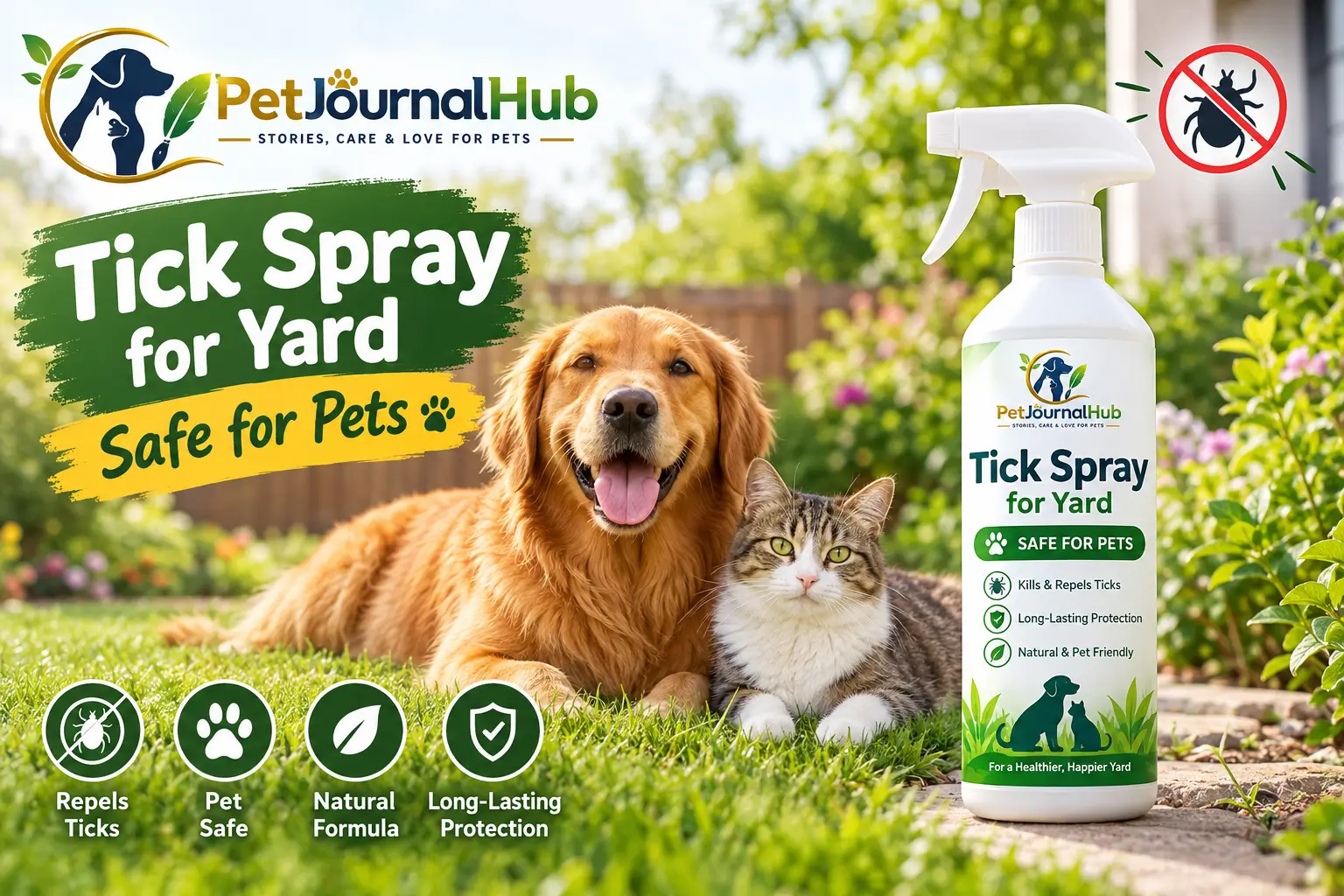
Featured Snippet Answer:
A pet-safe tick yard spray is a pesticide product labeled for outdoor tick control and appropriate for use around pets when used exactly as directed. Pet owners should remove animals, toys, bowls, and bedding before treatment. Keep pets away for the label’s required time, and combine treatment with mowing, leaf cleanup, and tick checks.
Key Takeaways
- Yard sprays can reduce ticks, but they should not replace pet tick prevention.
- Always choose a product whose label specifically covers your intended outdoor use.
- Remove pets, toys, food bowls, water bowls, and bedding before spraying.
- Keep pets away until the product dries or for the longer period stated on its label.
- Yard maintenance can reduce tick-friendly hiding places around frequently used areas.
- Never assume “natural” or “non-toxic” means risk-free for dogs, cats, birds, or other pets.
Introduction
Pet owners often search for a safer way to control ticks because a yard can become part of the tick problem. Dogs may pick up ticks while exploring grass, shrubs, wooded edges, or leaf litter. Those ticks can then enter the home with the pet.
Outdoor pesticide treatment can reduce tick numbers in treated areas. However, the CDC says spraying alone should not serve as your only strategy for reducing tick exposure. Yard management, personal protection, and regular tick checks still matter.
The bigger challenge involves balancing pest control with pet safety. A product that works against ticks still contains an active ingredient designed to affect pests. Your pet may contact treated grass, lick residues from fur, or walk across an area before it becomes safe for re-entry.
That makes the product label your most important safety tool.
This guide explains how yard tick sprays work, what pet owners should look for, how to prepare a yard, and when professional help makes sense. It also covers homemade and natural approaches without treating them as automatically harmless.
The goal is simple: reduce tick habitat and exposure while limiting unnecessary pesticide contact.
What Is tick spray for yard safe for pets?
A pet-safe yard tick spray refers to an outdoor tick-control product that provides directions for use around residential areas and explains when people and pets may return. “Pet-safe” does not mean the product poses zero risk.
Outdoor tick sprays usually contain an insecticidal active ingredient designed to control ticks. The label determines where you may apply the product, how to apply it, what precautions to take, and how long people or animals should stay away.
The National Pesticide Information Center advises removing pets and their belongings before pesticide application. It also recommends keeping animals away until the product dries and the area receives adequate ventilation, unless the label gives different instructions.
Why the label matters
Two products can target the same pest while having different instructions.
Check the label for:
- Target pests
- Outdoor application sites
- Mixing or dilution instructions
- Required protective equipment
- Re-entry instructions
- Weather restrictions
- Storage instructions
- First-aid information
- Species-specific warnings
The EPA also advises pet owners to read pesticide labels before buying, storing, or using these products.
Quick Facts Box
| Fact | Details |
| Main purpose | Reduce ticks in treated outdoor areas |
| Main safety rule | Follow the product label exactly |
| Before spraying | Remove pets, toys, bowls, food, and bedding |
| After spraying | Keep pets away for the label-required period |
| Yard maintenance | Mow grass and reduce leaf litter and brush |
| Best overall strategy | Combine habitat control, tick checks, and appropriate prevention |
| DIY approach | Avoid assuming homemade mixtures are automatically safe |
| Veterinary role | Ask your veterinarian about tick prevention for individual pets |
Where Does Yard Tick Control Come From?
Yard tick control grew from the broader need to reduce exposure to ticks around homes, recreational spaces, and property edges. Modern approaches combine landscaping, personal protection, animal protection, and pesticides when appropriate.
The CDC recommends several non-chemical yard measures. These include clearing tall grass and brush, removing leaf litter, mowing regularly, and creating a barrier between lawn areas and wooded edges.
That matters because spraying addresses the pest directly, while landscaping addresses some of the conditions that make a yard attractive to ticks.
The best approach therefore depends on the property itself. A small urban lawn may have different tick pressure from a home bordering woods or dense vegetation.
History and Evolution of Yard Tick Management
Tick management has gradually moved toward a more integrated approach. Instead of relying on one spray, homeowners can combine environmental changes with personal and pet protection.
This approach resembles integrated pest management, or IPM. NPIC recommends considering IPM before automatically choosing pesticide treatment.
Modern homeowners also have more product formats to consider. These include ready-to-use sprays, concentrates, granular products, and professional applications.
Each format creates different handling and exposure considerations.
For example, NPIC notes that some granular lawn products may require pets to stay away for 24 hours or longer while the product dissolves and the treated area dries. The exact requirement depends on the product label.
Key Characteristics and Care Needs
A good yard tick-control plan needs more than a bottle of spray. You should consider the product, the yard, your pets, and how your household uses the space.
Look for clear labeling
A useful product label should clearly explain its intended use. Avoid products with vague instructions or missing safety information.
Consider the yard layout
Ticks often create more concern around vegetation, wooded borders, and areas with leaf litter or tall grass. The CDC recommends clearing these areas around frequently used parts of the yard.
Think about every pet
Dogs and cats may behave differently around treated areas. Birds, reptiles, rabbits, and other small animals can also have different exposure concerns.
Never assume that a product appropriate for one animal automatically works for another.
Consider children too
If children use the yard, follow the same label restrictions that apply to people. Do not let children enter during application or before the label allows re-entry.
Quick Comparison Snapshot
| Option | Best For | Key Difference |
| Labeled ready-to-use yard spray | Small targeted areas | No home dilution required |
| Labeled concentrate | Larger yards | Requires correct dilution and handling |
| Granular tick-control product | Certain lawn applications | May require watering and longer exclusion |
| Professional treatment | Larger or difficult properties | Trained applicator handles product and application |
The table gives a general format comparison, not a product recommendation. Specific safety requirements depend on the individual label.
Homemade tick spray for yard safe for pets
Homemade tick sprays deserve caution because a household recipe does not automatically have a tested safety profile. Ingredients that seem mild can still irritate skin, eyes, paws, or the respiratory system.
Essential oils deserve particular caution around animals. Concentration, species, exposure route, and individual sensitivity can change the risk.
Instead of mixing a DIY pesticide, start with non-chemical yard management. Remove leaf litter, trim dense vegetation, mow regularly, and create a separation between lawns and wooded areas where practical.
If you still need pesticide treatment, choose a product with clear outdoor-use directions and follow the label. NPIC specifically recommends considering integrated pest management before pesticide use.
Best tick spray for yard safe for pets
There is no single product that fits every yard or household. The most suitable option depends on the target pest, application area, pets, yard layout, and label restrictions.
Rather than choosing based only on phrases such as “pet friendly,” read the complete label.
Look for:
- Tick control listed among the target pests.
- Outdoor residential use.
- Clear application instructions.
- Specific re-entry directions.
- Storage and first-aid information.
- An active ingredient clearly identified on the label.
The EPA explains that pesticide labels provide instructions for safe and effective use, storage, and first aid.
A professional pest-control company can also help when your property presents unusual challenges. Ask which product they plan to use and what precautions your pets need.
Natural tick spray for yard safe for pets
“Natural” describes an ingredient source, not a guarantee of safety. Some naturally derived substances can still affect pets, people, insects, or wildlife.
This is especially important when products contain concentrated plant oils. A pet may encounter residue through paws, fur, licking, or direct contact.
A safer natural-first strategy starts with physical yard management:
- Remove leaf litter.
- Cut back dense brush.
- Keep grass maintained.
- Reduce clutter around the yard.
- Keep frequently used areas away from dense vegetation.
- Limit conditions that attract wildlife when practical.
These measures align with CDC recommendations for reducing tick exposure around homes.
If you want to use a botanical pesticide, check its complete label rather than relying on the word “natural.”
Tick spray for yard safe for pets and kids
A yard treatment suitable for a household with children still requires careful application. Children and pets should stay away during treatment and for the period specified by the product label.
Before application, remove outdoor toys and other items children or pets may touch. Remove pet bowls, bedding, chew toys, and similar belongings from the treatment area.
The EPA recommends removing children, toys, and pets before pesticide application and keeping them away until the product dries or the label gives another required interval.
Weather also matters. EPA guidance advises against outdoor pesticide spraying during windy or rainy conditions because drift and runoff can create additional exposure concerns.
Tick Spray for yard safe for pets Home Depot
Home-improvement stores may carry several outdoor insect-control products, but store availability does not establish that a particular product suits your pets.
When shopping, ignore the front-label marketing for a moment. Turn the package over and read the directions.
Check:
- Whether ticks appear on the target-pest list.
- Whether the product covers your intended yard area.
- Whether pets must leave during application.
- When pets may return.
- Whether watering changes the waiting period.
- Whether the product requires dilution.
- Whether the label includes species-specific warnings.
Do not choose a product simply because another pet owner used it successfully. Your yard, pets, product, and exposure conditions may differ.
Best mosquito and tick spray for yard
Some yard products target more than one pest, including mosquitoes and ticks. A combined product may make sense when both pests create problems, but broader pest coverage does not automatically make a product safer or more effective for your situation.
Start by identifying which pests actually affect your yard.
If ticks remain the primary concern, focus on tick habitat and exposure. If mosquitoes also cause problems, look for a product whose label specifically covers both pests.
The CDC recommends not relying on pesticide treatment alone for reducing tick-related infection risk.
For mosquito control, also remove standing water where practical. That addresses breeding habitat rather than only treating adult insects.
Flea and tick spray for dogs homemade
Do not treat a homemade flea-and-tick mixture as a substitute for veterinary parasite prevention. A product intended for your yard and a product intended for direct use on a dog serve different purposes.
Some pesticides can cause problems when applied incorrectly. NPIC warns that pesticide exposure can occur through ingestion, skin contact, or breathing the product.
Dogs also vary by age, size, health status, and sensitivity.
For a flea or tick product that goes directly onto your dog, follow the product’s animal-specific label and ask your veterinarian if you have concerns. Never transfer a yard pesticide onto your pet.
That distinction is critical.
Yard treatment belongs on the yard. Animal treatment requires an animal-labeled product.
Most effective Tick spray for yard
Effectiveness depends on more than the pesticide itself. Application timing, coverage, weather, tick species, property conditions, and continued exposure can all affect results.
The CDC notes that outdoor pesticides can reduce ticks in treated yard areas, but it does not recommend relying on spraying alone.
For a stronger overall plan, combine chemical and non-chemical measures.
Focus treatment and yard maintenance around places where people and pets spend time. Maintain the lawn, clear leaf litter, manage vegetation, and reduce wildlife access where practical.
Then continue checking pets after outdoor activity.
A spray can reduce exposure without eliminating every tick from a property.
How to Get Started Safely
Start with the yard rather than the bottle.
Step 1: Inspect the property
Look around lawn edges, brush, leaf piles, wooded borders, and places where pets frequently explore.
Step 2: Reduce tick-friendly habitat
Mow grass and clear leaf litter and dense vegetation around commonly used areas. The CDC recommends these steps as part of tick-risk reduction.
Step 3: Read the complete product label
Confirm that the product targets ticks and works for your intended outdoor application.
Step 4: Prepare pets and belongings
Remove pets from the treatment area. Remove their bowls, bedding, toys, and food.
Step 5: Apply exactly as directed
Do not increase the concentration because you want faster results. More product does not automatically mean better control.
Step 6: Respect the re-entry period
Keep pets and people away until the label allows them to return.
Step 7: Continue checking pets
Even after yard treatment, inspect pets regularly after outdoor activity.
NPIC recommends regular tick checks for people and pets.
Cost Breakdown
Yard tick-control costs vary widely, so a fixed price would mislead readers.
Your total cost may depend on:
- Yard size
- Product type
- Ready-to-use versus concentrate
- Number of applications
- Equipment requirements
- Local product availability
- Professional service fees
- Landscaping work needed
DIY treatment may reduce service costs, but it places the responsibility for label compliance and application on the homeowner.
Professional treatment adds labor and service costs. In return, you can ask the applicator about product selection, application areas, pet precautions, and re-entry requirements.
Before hiring a company, ask what pesticide they plan to use and what precautions your pets require. NPIC recommends discussing product risks with lawn or pest-control professionals.
Common Mistakes Pet Owners Make
Many problems come from treating pesticide safety as an afterthought.
Mistake 1: Letting pets stay nearby
Pets should leave the treatment area before application begins.
Mistake 2: Returning too soon
Drying time does not always equal the exact re-entry requirement. Follow the label.
Mistake 3: Leaving bowls outside
Food and water bowls can collect product during application. Remove them first.
Mistake 4: Assuming natural means harmless
Natural ingredients can still cause unwanted exposure.
Mistake 5: Mixing products
Combining pesticides or other chemicals can create unexpected risks.
Mistake 6: Using yard products on pets
A lawn pesticide does not become a pet treatment simply because it controls ticks.
Mistake 7: Ignoring landscaping
Ticks can continue entering treated areas from surrounding vegetation and wildlife activity.
Mistake 8: Skipping pet tick prevention
A treated yard does not eliminate every tick exposure route.
Pros and Cons
| Pros | Cons |
| Can reduce ticks in treated areas | Does not eliminate every tick |
| Works alongside yard maintenance | Requires careful label compliance |
| Can target problem areas | Pets must stay away during treatment |
| Some products cover multiple pests | Some treatments require repeated applications |
| Professional application is available | Service adds cost |
| Can complement pet prevention | Does not replace veterinary parasite prevention |
Similar Options and Alternatives
| Option | Best For |
| Regular mowing | Keeping frequently used lawn areas maintained |
| Leaf-litter removal | Reducing tick-friendly hiding areas |
| Brush management | Homes beside wooded or overgrown areas |
| Wood-chip or gravel barrier | Separating lawn from wooded edges |
| Professional pest treatment | Large or challenging properties |
| Veterinary tick prevention | Protecting pets directly |
| Routine tick checks | Finding ticks before they remain attached longer |
| Wildlife management | Properties with repeated wildlife activity |
The CDC specifically recommends removing leaf litter, clearing tall grass and brush, mowing regularly, and using certain barriers around lawn and wooded edges.
When to Consult a Vet or Professional
Contact your veterinarian if you have questions about choosing tick prevention for your individual pet. This becomes especially important for pets with unusual health needs, previous reactions, or complex medication routines.
NPIC recommends discussing flea and tick control options with a veterinarian when selecting products for animals.
Seek professional pest-control help when the property has persistent tick problems despite reasonable yard maintenance.
If you suspect pesticide exposure, contact a veterinarian promptly. NPIC also advises contacting an animal emergency resource for emergencies.
Keep the product container or label available. The active ingredient and product instructions can help professionals understand what happened.
Fun Facts
- Ticks can enter homes on pets even when the yard receives treatment.
- The CDC recommends regular mowing as part of tick-risk reduction.
- Leaf litter can provide habitat where ticks remain protected.
- Yard spraying does not replace personal tick precautions.
- Pets should receive regular tick checks after outdoor activity.
- Some granular pesticide products require longer pet exclusion periods.
- Pesticides can expose pets through skin contact, ingestion, or inhalation.
- The word “natural” does not guarantee that a pesticide carries no risk.
These points reflect guidance from CDC and NPIC rather than a claim that every yard has the same tick risk.
Frequently Asked Questions
How to get rid of ticks in yard without harming pets?
Start with non-chemical measures before reaching for a pesticide. Keep grass maintained, remove leaf litter, clear dense brush, and create a separation between lawn areas and wooded edges where practical. These steps can reduce places where ticks may persist around commonly used areas.
You should also check pets after outdoor activity and discuss appropriate tick prevention with your veterinarian. If pesticide treatment becomes necessary, remove pets and their belongings before application. Follow the label’s re-entry instructions exactly. There is no universal “pet-safe” waiting period because products differ.
What kills ticks but is safe for dogs?
There is no single tick-killing ingredient that you should assume works safely for every dog. Safety depends on the product, concentration, application method, dog, and label directions.
For yard treatment, use only products labeled for the intended outdoor application. Never apply a yard pesticide directly to a dog. For products used directly on dogs, choose an animal-labeled product and follow its instructions. NPIC advises pet owners to ask veterinarians about appropriate flea and tick control options.
If your dog has reacted to a pesticide before, discuss future options with your veterinarian.
What is a safe non-toxic tick spray for my yard?
“Non-toxic” can create a misleading sense of certainty because toxicity depends on the substance, dose, exposure route, and animal involved. A product’s marketing language should never replace its complete label.
For a lower-exposure strategy, begin with yard maintenance. Remove leaf litter, maintain grass, clear brush, and reduce tick-friendly areas around frequently used spaces. If you choose a pesticide, select one with clear directions for your intended use and follow those instructions exactly.
NPIC recommends integrated pest management as something to consider before pesticide use.
Is tick spray harmful to dogs?
Tick spray can pose a risk to dogs if the animal contacts, inhales, or ingests a pesticide improperly. The actual risk varies by product, exposure amount, active ingredient, and individual animal.
That does not mean every labeled yard treatment will harm a dog. Proper use can reduce exposure significantly. Remove your dog before treatment, take away bowls and toys, and keep the dog out for the label-required period. NPIC specifically advises keeping pets away from treated areas until the product dries or the label provides another instruction.
If exposure occurs or your dog develops concerning signs, contact your veterinarian promptly.
Internal Links for PetJournalHub.com
I recommend linking this article to three relevant PetJournalHub content areas:
- Pet Care: /blog/pet-care/ — use naturally around tick prevention and routine pet checks.
- Product Reviews: /blog/product-reviews/ — use when discussing how to evaluate pet-safe pest-control products.
- Best Pets: /blog/best-pets/ — use only where an article discusses species-specific outdoor-care considerations.
These are category-level internal-link targets. I would not invent individual PetJournalHub article URLs without confirming that those articles currently exist.
Authoritative External Sources
- CDC — Preventing Tick Bites — yard-management and tick-exposure guidance.
- EPA — Read the Label First: Protect Your Pets — pesticide-label and pet-safety guidance.
- National Pesticide Information Center — Pesticide Use Around Pets — practical pesticide-exposure precautions for pets.
Final Thoughts
A safer tick-control plan starts with a simple idea: reduce exposure instead of relying on one spray to solve everything.
Good yard maintenance can reduce places where ticks persist. Regular pet checks can help you find ticks after outdoor activity. Appropriate veterinary prevention can address the ticks your pet encounters outside the yard.
When you decide to use a pesticide, treat the label as the final authority for that product. Remove pets and their belongings before application, follow the application directions, and respect the required re-entry period.
Do not let phrases such as “natural,” “green,” or “pet friendly” replace careful label reading. Products differ, and pets differ too.
For persistent tick problems, a veterinarian and qualified pest-control professional can help you build a plan suited to your household. A thoughtful combination of landscaping, prevention, monitoring, and carefully selected treatment usually makes more sense than simply spraying more often.

Sophia Bennett is an animal care contributor at PetJournalHub. She writes educational articles about companion animals, pet wellness, training, and daily care. She believes that trustworthy information helps every pet owner build a healthier and happier life for their pets.