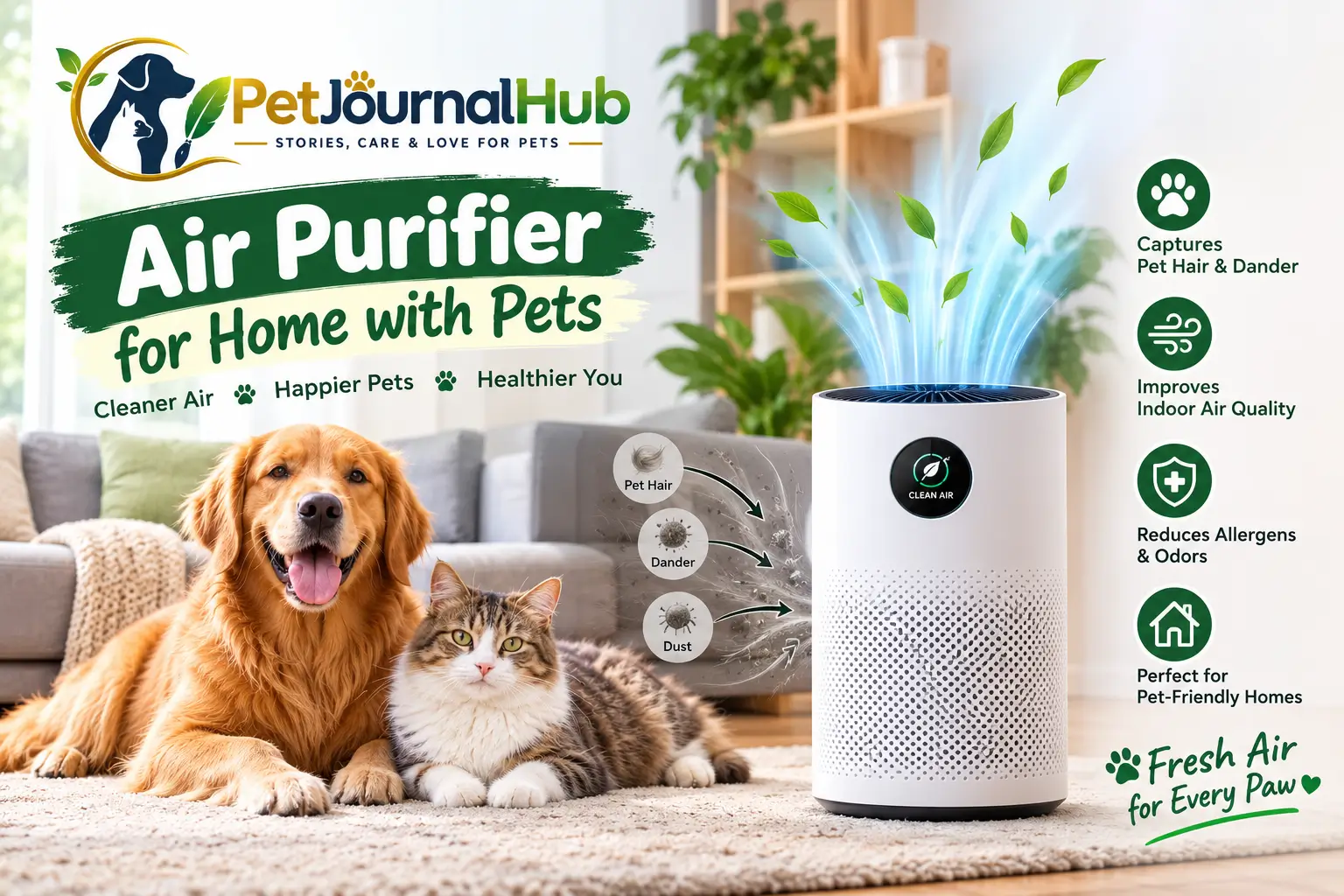
An air purifier for home with pets is a portable device that filters indoor air to reduce airborne particles such as pet dander, dust, pollen, and smoke. Models with activated carbon can also help with some household odors. For pet owners, the right purifier should match room size, airflow needs, filter type, maintenance cost, and safe operation.
Key Takeaways
- Choose a purifier based on room size and CADR, not the word “pet” on the box.
- HEPA or high-efficiency mechanical filtration helps capture airborne particles such as dander and fine dust.
- Activated carbon can help with some pet and household odors, but it does not replace cleaning.
- A washable pre-filter can make maintenance easier in homes with shedding pets.
- Large pet hair usually needs grooming and vacuuming because much of it settles before a purifier can capture it.
- Avoid air cleaners that intentionally generate ozone, and keep the appliance safely away from chewing, climbing, or water hazards.
Introduction
Dogs, cats, birds, rabbits, and other companion animals make a home feel more lively. They can also change the indoor air. Fur collects on furniture, dander settles on bedding, dust follows pets indoors, and litter or wet-coat odors can linger.
That explains why many pet owners search for an air purifier for home with pets. They want cleaner air without turning every day into a deep-cleaning session.
A purifier can help, but it does not solve every pet-related air problem. Airborne particles and settled hair require different solutions. A purifier works on air that passes through its filters. A vacuum handles particles and hair that already sit on floors, carpets, sofas, and pet beds.
The right machine also depends on your home. A compact bedroom needs less airflow than a large open living room. A home with several shedding pets may need more filtration than a single-pet household. Odor concerns also change the filter requirements.
For pet owners in Pakistan, there is another practical issue: replacement filters. A machine may look affordable at first, but filter availability can determine its real long-term cost.
This guide explains the features that matter, how to use a purifier around pets, what to expect from different filter types, and how to avoid common buying mistakes.
What Is an Air Purifier for Home With Pets?
An air purifier is a portable appliance that pulls room air through one or more filters and releases filtered air back into the room. Pet-focused models do not necessarily use a special type of technology. Instead, they usually combine particle filtration, airflow, and sometimes odor filtration.
The EPA describes portable air cleaners as a supplement to source control and ventilation. They can reduce some indoor pollutants, but no portable purifier removes everything from a home.
For a pet household, the main targets include:
- Pet dander
- Fine dust
- Pollen
- Smoke particles
- Some airborne fibers and small hair particles
- Certain odor-causing gases when activated carbon is present
Pet dander deserves special attention. Pet allergies usually involve proteins from skin flakes, saliva, or urine rather than the hair itself. Hair and fur can carry those allergens around the home.
That difference matters when choosing equipment. A purifier should support your cleaning routine rather than replace it.
Quick Facts Box
| Fact | Details |
| Main job | Filters some airborne pollutants |
| Main pet target | Airborne dander and fine particles |
| Particle filter | HEPA or another high-efficiency mechanical filter |
| Odor support | Activated carbon |
| Large pet hair | Usually needs vacuuming and grooming |
| Room sizing | Compare CADR and room size |
| Maintenance | Clean or replace filters according to the manufacturer |
| Safety | Avoid intentionally ozone-generating devices |
| Best approach | Combine filtration with cleaning and source control |
Key Characteristics / Care Needs
The right purifier depends on several features rather than one marketing label.
HEPA and high-efficiency filtration
HEPA refers to a high-efficiency mechanical filter. The EPA notes that HEPA filters can theoretically remove at least 99.97% of particles at 0.3 microns under specified test conditions. That figure does not mean a purifier removes 99.97% of every pollutant from an entire house.
Real performance depends on airflow, filter condition, room size, placement, and operating time.
Activated carbon
Carbon serves a different purpose from particle filtration. It can adsorb certain gases and odor compounds.
If pet odor matters to you, look for a purifier with a meaningful carbon layer. The EPA notes that carbon filters can help with gases, but performance depends heavily on how much carbon the filter contains.
CADR
CADR means Clean Air Delivery Rate. It helps consumers compare how much filtered air a purifier delivers.
A higher CADR generally suits a larger room. The EPA provides room-sizing guidance based on CADR and notes that higher fan speeds and longer operating times increase filtration.
Pre-filter
A pre-filter catches larger particles before they reach the main filter. This feature can prove useful in homes with heavy shedding.
Some pre-filters can be washed or cleaned. Never assume the main HEPA filter has the same feature.
Noise
A purifier can run for long periods, so noise matters.
Some pets ignore a purifier. Others may react to the motor or sudden fan changes. Introduce a new machine gradually and give your pet space to investigate it without pressure.
Quick Comparison Snapshot
| Option | Best For | Key Difference |
| Xiaomi Smart Air Purifier 4 Compact | Smaller rooms | Compact size and local Pakistan availability |
| Levoit Core 300S | Bedrooms and compact spaces | Smart controls and multi-stage filtration |
| Xiaomi Smart Air Purifier 4 | Medium rooms | Higher airflow and smart air-quality monitoring |
| Xiaomi Smart Air Purifier 4 Pro | Larger rooms | Higher-capacity design for larger spaces |
These are examples of products that illustrate different buying priorities. They do not represent a universal ranking.
Xiaomi Pakistan lists the Smart Air Purifier 4 with particle CADR up to 400 m³/h, while local Pakistani listings also show several Xiaomi models and replacement filters.
A local Karachi retailer currently lists the Levoit Core 300S at Rs. 59,500, although prices can change.
Air purifier for home with pets price in pakistan
Prices in Pakistan vary by brand, model, seller, warranty, and stock. Replacement-filter costs can also change the long-term value of a purifier.
Current local listings illustrate a broad range. Xiaomi Pakistan-related retail listings show models from the Smart Air Purifier 4 Compact at about Rs. 37,499 to larger models such as the Smart Air Purifier 4 Pro at about Rs. 89,999.
A local retailer currently lists the Levoit Core 300S at Rs. 59,500.
Treat these figures as market snapshots rather than fixed prices. Sellers can change prices, discounts, stock, and warranty terms.
Before buying, calculate the full ownership cost:
- Purchase price
- Replacement filters
- Electricity use
- Delivery charges
- Warranty or service costs
- Availability of genuine filters
A cheaper purifier may cost more over several years if its filters are expensive or difficult to find.
Air purifier for home with pets in pakistan
Pakistani pet owners should consider both indoor pet pollutants and the wider indoor-air environment.
Dust and outdoor pollution can enter through doors, windows, clothing, and ventilation. Seasonal air-quality conditions may also change how often you want to run a purifier.
Filter access deserves special attention. Search for the exact replacement-filter model before purchasing the machine. Do not rely only on a seller saying that “filters are available.”
Check whether the seller carries replacement filters or whether another reliable local source stocks them.
Voltage also matters for imported appliances. Confirm the product’s electrical requirements before plugging it into your home.
For homes with central HVAC systems, a suitable HVAC filter can complement a portable purifier. The EPA recommends using a MERV 13 filter, or the highest compatible rating, when the HVAC system can handle it.
Best air purifier for pets and dust
A purifier with strong particle filtration and enough airflow can help reduce airborne dust and dander. It will not replace vacuuming settled dust.
Dust and pet hair often land on floors, carpets, furniture, and bedding. A purifier cannot reach every particle sitting on those surfaces.
For a dusty pet home, prioritize:
- High-efficiency particle filtration
- Adequate CADR
- A useful pre-filter
- Easy filter maintenance
- Affordable replacement filters
- Continuous or automatic operating modes
Placement also matters. Keep the intake and outlet clear. Do not hide the machine behind a sofa or curtain.
If your pet spends most of its time in one room, that room may deserve the purifier first. A large home may require multiple units if you want filtration in several separate areas.
The EPA notes that portable cleaners work on individual rooms or areas, while HVAC filtration can serve a larger connected space.
Best air purifier for home with pets
The best purifier for your household depends on what you want it to accomplish.
For dander and fine dust, prioritize particle filtration and airflow. For odors, look for activated carbon. For heavy shedding, consider a good pre-filter and easy maintenance.
Room size should come before smart features.
A phone app, air-quality display, or voice control can make a purifier easier to use. Those features do not compensate for inadequate airflow.
For example, Xiaomi’s Smart Air Purifier 4 includes particle filtration, activated carbon, air-quality monitoring, app control, and a stated particle CADR of up to 400 m³/h.
The right model remains the one that matches your room and maintenance needs.
Best air purifier for pet hair
Air purifiers can capture some airborne fibers and small particles, but they do not replace a vacuum.
Large pieces of dog or cat hair often settle quickly. A vacuum can remove that material from carpets, floors, furniture, and pet beds more effectively.
A pet-home purifier should therefore support your cleaning routine.
Look for:
- A strong pre-filter
- Easy access to the filter
- Good airflow
- A suitable CADR
- Reasonable replacement-filter costs
- A stable design that your pet cannot easily knock over
Grooming also helps reduce loose hair before it reaches your floor.
The exact grooming schedule depends on the animal, coat, and health needs. Follow species- and breed-appropriate grooming guidance rather than assuming every pet needs the same routine.
Best air purifier for pet allergies and asthma
Air purification can support allergy-control efforts, but it should not become the only strategy.
The American Academy of Allergy, Asthma & Immunology explains that pet allergens come from proteins found in dander, saliva, and urine. Hair and fur can carry these allergens.
The organization also recommends measures such as cleaning surfaces and using HEPA filtration as part of allergen management.
For a household dealing with allergies or asthma, consider a broader plan:
- Use suitable high-efficiency filtration.
- Clean floors and soft surfaces regularly.
- Wash pet bedding as appropriate.
- Keep allergy-sensitive sleeping areas cleaner.
- Follow medical advice for diagnosed allergies or asthma.
An air purifier cannot remove allergens that have already settled on a sofa or carpet.
If a person has persistent breathing symptoms, they should follow their healthcare professional’s advice. If a pet develops breathing problems, coughing, or other concerning symptoms, contact a veterinarian.
Best air purifier for pets with washable filter
A washable pre-filter can be useful in a pet home, especially when an animal sheds heavily.
The pre-filter can catch larger hair, lint, and debris before those materials reach the main filter.
However, do not confuse a washable pre-filter with a washable HEPA filter.
Read the manual carefully. Some machines allow pre-filter cleaning while requiring replacement of the main filter.
Never wash a disposable filter unless the manufacturer explicitly allows it. Water can damage filter media or affect how the filter performs.
Also consider how easy the pre-filter is to remove. A feature becomes less useful if cleaning requires taking apart half the machine.
Air purifier for home with pets price
The sticker price tells only part of the story.
Suppose two purifiers have similar purchase prices. One uses an inexpensive, widely available replacement filter. The other uses an imported filter that costs much more. Their long-term costs can differ significantly.
Create a simple ownership estimate before buying.
| Cost | What to Check |
| Initial machine | Current retail price |
| Main filter | Replacement price |
| Replacement interval | Manufacturer guidance |
| Pre-filter | Washable or disposable |
| Electricity | Rated power and daily use |
| Warranty | Local coverage |
| Delivery | Shipping or import charges |
Xiaomi’s Pakistan listings currently show replacement filters for several models, which can make maintenance easier for local buyers.
Prices change, so check the current seller listing before publishing or purchasing.
Daily Care Routine / How to Get Started
Setting up a purifier correctly matters almost as much as choosing one.
1. Measure the room
Calculate the approximate floor area of the room where you want filtration.
If the room has unusually high ceilings or an open layout, consider a larger capacity. The EPA notes that room size and CADR should guide portable air-cleaner selection.
2. Choose the main problem
Decide whether your priority involves:
- Dander
- Dust
- Smoke
- Odors
- General indoor particles
That choice helps you decide between particle-focused and particle-plus-carbon filtration.
3. Position the purifier properly
Place it where air can move freely around the intake and outlet.
Avoid blocking the unit with furniture, curtains, blankets, or pet beds.
4. Introduce it gradually
If your pet reacts to unfamiliar sounds, start at a lower setting.
Let the animal move away if it wants to. Do not force your pet to stay beside the machine.
5. Keep cleaning
Continue vacuuming, dusting, grooming, and washing pet bedding.
A purifier works best when you reduce pollution sources as well as filter airborne particles.
6. Maintain the filters
Check the filter according to the manufacturer’s instructions.
Heavy shedding, dusty rooms, and frequent operation may increase the maintenance burden.
Common Mistakes Pet Owners Make
Several mistakes can reduce the value of an otherwise good purifier.
Buying by coverage claims alone
Manufacturers may use different testing methods for room coverage. CADR provides a more useful comparison for particle removal.
Expecting a purifier to remove all pet hair
A purifier is not a vacuum cleaner. Large hair usually needs mechanical cleaning.
Ignoring activated carbon
A particle filter and an odor filter perform different jobs. If odor matters, check the carbon stage.
Forgetting replacement filters
Always research the replacement filter before purchasing the machine.
Hiding the purifier
Blocking the intake or outlet can restrict airflow.
Using fragrance to cover odors
Masking an odor does not solve its source. Clean the litter area, bedding, floors, or other affected surfaces instead.
Ignoring ozone concerns
The EPA advises consumers to avoid portable air cleaners that intentionally produce ozone because ozone can irritate the lungs.
Treating a pet’s symptoms with an appliance
A purifier can support indoor-air management. It cannot diagnose or treat a pet’s illness.
Pros and Cons
| Pros | Cons |
| Helps filter some airborne particles | Does not clean settled hair |
| Can reduce airborne dander | Does not remove every allergen |
| Carbon can help with some odors | Carbon performance varies |
| Useful alongside regular cleaning | Requires filter maintenance |
| Portable models target specific rooms | One unit may not cover an entire home |
| Can support cleaner indoor air during smoke events | Electricity and replacement filters add ongoing cost |
Similar Products and Alternatives
The alternatives below solve different parts of the pet-home problem.
| Option | Best For |
| HEPA vacuum | Removing settled dander, dust, and hair |
| Central HVAC filtration | Filtering air across connected rooms |
| Washable pre-filter purifier | Homes with heavier shedding |
| Activated-carbon purifier | Homes where odors are a major concern |
| Portable purifier | Bedrooms or individual pet-heavy rooms |
| Mechanical ventilation | Bringing in cleaner outdoor air when conditions allow |
The EPA emphasizes source control and ventilation alongside filtration. A purifier should therefore form part of a broader indoor-air strategy rather than serve as the only solution.
When to Consult a Vet or Professional
Air purification belongs to home management, not veterinary diagnosis.
Contact a veterinarian if your pet develops persistent coughing, breathing difficulty, repeated sneezing, unusual nasal discharge, or another symptom that concerns you.
Do not assume that an air purifier will solve respiratory symptoms.
You may also want professional help when indoor-air problems have a clear building source. Persistent mold, moisture damage, major smoke exposure, or ventilation problems require source control.
The EPA specifically notes that air cleaners do not solve mold problems because the moisture source must be addressed.
During wildfire smoke or other severe outdoor pollution events, the EPA recommends cleaner-air strategies for pets, including portable air cleaners and keeping pets indoors when conditions require it.
Bird owners should take particular care during smoke events because birds can be especially sensitive to smoke exposure.
Fun Facts
- Pet hair and pet dander are not the same thing.
- Hair can carry allergens from a pet’s skin, saliva, or urine.
- CADR measures clean-air delivery rather than simply filter quality.
- Activated carbon and particle filters perform different jobs.
- A purifier cannot remove every pollutant from indoor air.
- Higher fan speeds generally move more air through a purifier.
- Filter condition affects purifier performance.
- A purifier works best alongside source control and cleaning.
Frequently Asked Questions
Are air purifiers worth it if you have pets?
They can be useful for households that want to reduce airborne particles from pets, dust, pollen, or smoke. Their value depends on the room, purifier capacity, filter quality, and how consistently you use the machine.
They make the most sense when you treat them as one part of a cleaning routine. Vacuuming, grooming, washing bedding, and cleaning litter areas still matter.
The EPA considers portable air cleaners a supplement to source control and ventilation rather than a complete indoor-air solution.
For pet owners, the biggest mistake involves expecting one appliance to solve every hair, dander, and odor problem.
What is the best air purifier for home with pets?
There is no single model that fits every pet household. Room size, CADR, filter type, odor concerns, noise, budget, and replacement-filter access all affect the choice.
For a small bedroom, a compact purifier may provide enough airflow. Larger living areas need a higher-capacity unit. Homes with strong pet odors may benefit from substantial activated-carbon filtration.
For Pakistani buyers, local replacement filters deserve special attention. A purifier that becomes difficult to maintain may create more expense later.
Choose the machine based on your room and actual problem rather than choosing it only because the manufacturer labels it “pet.”
Do air purifiers help your house not smell like a dog?
They can help with some airborne odor compounds, particularly when the purifier includes activated carbon. However, a purifier cannot remove the source of every pet smell.
Start by identifying where the odor comes from. Wash bedding, clean floors, remove waste, and keep food areas clean. If the smell comes from the animal itself, investigate the cause rather than simply masking it.
A sudden or unusual odor from a pet’s ears, mouth, skin, or coat can signal a health issue. In that situation, contact a veterinarian.
For normal household odors, filtration works best alongside source control.
Do air purifiers really help with dust and pet hair?
They can help with airborne dust and some small airborne particles, but they do not replace vacuuming.
Large pieces of pet hair often settle on surfaces. A purifier may never capture them because they leave the air before reaching the intake.
Use the purifier for airborne particles and use a vacuum for floors, carpets, furniture, and pet beds.
A washable or cleanable pre-filter can also help in a heavy-shedding home. It catches larger debris before that material reaches the main filter.
This combination usually makes more sense than expecting one appliance to perform every cleaning task.
Can I leave an air purifier running while my pet is home?
Many portable purifiers operate continuously, but you should follow the manufacturer’s instructions for your specific model.
Place the machine somewhere your pet cannot easily knock it over or chew its power cord. Keep water bowls and other spill risks away from electrical equipment.
If your pet reacts to fan noise, introduce the appliance gradually. Watch its behavior during the first few uses.
Also avoid devices that intentionally generate ozone. The EPA advises consumers to avoid ozone-generating air cleaners.
How often should I replace an air purifier filter in a pet home?
There is no universal replacement interval. The correct schedule depends on the purifier, filter design, operating time, indoor dust level, and number of pets.
Follow the manufacturer’s filter indicator or maintenance instructions.
A home with several shedding animals may load filters faster than a low-dust home. Check the filter regularly instead of assuming the calendar alone determines replacement time.
Never wash a disposable filter unless the manufacturer specifically permits it.
Final Thoughts
A purifier can make sense in a pet-friendly home, but the right machine depends on what you actually want to control.
For airborne dander and fine dust, focus on efficient particle filtration and enough airflow for the room. For persistent household odors, look for activated carbon. For heavy shedding, a useful pre-filter can make maintenance easier.
Do not overlook the basics. Groom your pet, vacuum regularly, wash bedding, clean litter areas, and address odors at their source.
For Pakistani buyers, replacement-filter availability deserves special attention. Check the exact filter model and current local price before buying the appliance.
Most importantly, keep expectations realistic. A purifier filters air. It does not replace cleaning, ventilation, veterinary care, or responsible pet ownership.
With the right size, sensible placement, regular maintenance, and a safe filtration system, it can become a practical part of a cleaner pet-friendly home.

Daniel Brooks is a pet research writer at PetJournalHub. He specializes in pet behavior, product research, and responsible pet ownership. He focuses on delivering accurate, reader-friendly guides that help pet owners provide the best care for their animals.