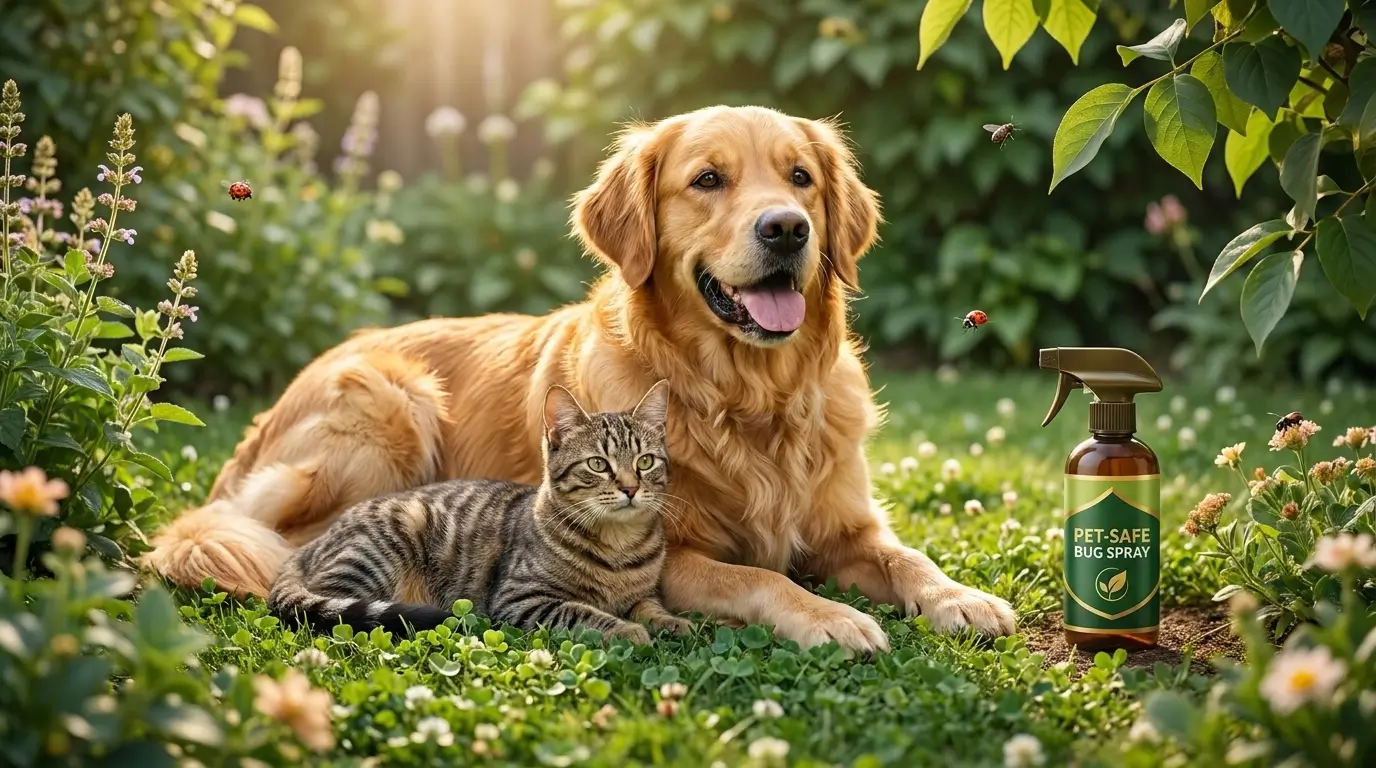
Bug spray safe for pets means choosing a pest-control product that matches your animal, the target pest, and the place where you plan to use it. No spray is automatically safe for every pet. Always read the label, keep animals away during application, and follow the product’s full re-entry instructions before allowing them back into treated areas.
Key Takeaways
- Choose pest-control products according to your pet’s species, age, health, and exposure risk.
- Never assume that plant-based, essential-oil, or homemade sprays are harmless.
- Keep pets away during application and for the entire period specified on the product label.
- Never spray household insecticides directly onto your pet unless the label specifically approves that use for that species.
- Cats need special care around certain insecticides, including some concentrated permethrin products.
- Contact your veterinarian or an animal poison service promptly if your pet shows signs of exposure or poisoning.
Introduction
Bugs can make life uncomfortable for both pets and their owners. Mosquitoes gather around outdoor water bowls, ants enter food areas, and flies hover around litter boxes or waste bins. Fleas and ticks can also threaten animal health. Naturally, many pet owners want to control pests without exposing their furry companions to harmful chemicals.
Finding an appropriate insect spray takes more than choosing a product marked “natural” or “pet-friendly.” The right choice depends on the active ingredient, concentration, application method, treated surface, and animal that might come into contact with it. A spray designed for outdoor plants may not suit a living room. A product made for dogs may pose serious risks to cats.
Pet owners also need to distinguish between household insecticides, outdoor yard treatments, and veterinary flea or tick products. These products serve different purposes, so you should never treat them as interchangeable.
This guide explains how to compare common pest-control options, reduce insect problems around pets, and recognize situations that require professional advice. It also covers indoor and outdoor treatments, homemade remedies, mosquito protection, citronella, and practical alternatives.
The goal is simple: control pests while reducing unnecessary exposure for your animals. Before purchasing any product described as bug spray safe for pets, check its complete label and confirm that its intended use matches your household.
What Is Bug Spray Safe for Pets?
This term refers to insect-control products that people can use around animals when they follow the product’s specific safety directions. It does not describe one universal formula or guarantee that every animal can tolerate the product.
Three product categories matter most:
- Household insecticides: These target ants, cockroaches, flies, and other indoor pests. Their labels may restrict access to treated rooms or surfaces.
- Outdoor pest-control sprays: These treat lawns, patios, shrubs, or other outdoor areas. Spray drift, runoff, and contact with treated plants can expose pets.
- Animal-specific repellents and parasite treatments: These target particular pests on an animal or its coat. Use them only for the species and purpose listed on the label.
The difference matters because a household spray might control mosquitoes in a room without being suitable for application to a dog’s coat. Likewise, a dog flea treatment may contain an ingredient that poses a serious danger to cats.
The U.S. Environmental Protection Agency (EPA) advises consumers to read pesticide labels for instructions on safe use, storage, and first aid. Read the EPA’s pesticide label guidance before buying or applying a product.
Quick Facts Box
| Fact | Details |
| Main purpose | Control or repel insects around pets |
| Common pests | Mosquitoes, ants, flies, fleas, and ticks |
| Main safety factor | Active ingredient, concentration, and exposure |
| Indoor use | Follow room-specific directions and re-entry rules |
| Outdoor use | Check lawn, garden, and pet-access restrictions |
| Homemade sprays | Not automatically safe or effective |
| Best first step | Identify the pest and read the complete label |
| When to call a vet | Suspected poisoning, unusual symptoms, or direct exposure to a concerning product |
Where Does This Type of Pest Control Come From?
Insect sprays come from the wider field of pest management. Manufacturers develop different formulations to kill insects, repel them, or interrupt parts of their life cycle. Some products contain synthetic chemicals, while others use plant-derived ingredients.
The term “pet-safe” does not identify a single chemical class. It also does not replace a product’s approved directions. A formula’s risks depend on its ingredients, concentration, application method, and the animal’s exposure.
Pet owners now have access to many types of pest-control products, including sprays, traps, baits, and veterinary parasite preventives. However, popularity or a “natural” label does not prove that a product is safe for every species.
History and Evolution of Pet-Conscious Pest Control
People have long used chemical and plant-based methods to manage insects. Modern pest control adds more targeted formulations, detailed labels, and instructions for limiting exposure to people, pets, and the environment.
Veterinary parasite products also developed into a distinct category. These products target specific parasites and animal species, unlike general household insecticides.
Today’s pet-conscious approach focuses on matching the treatment to the pest and location while reducing unnecessary contact. Rather than relying on a product’s marketing claims, owners should review its directions and consider nonchemical steps, such as removing standing water and sealing entry points.
Key Characteristics and Safety Needs
A suitable pest-control plan considers more than whether a bottle says “pet-friendly.” The following factors help determine whether a product fits your home.
Active ingredients and concentration
The active ingredient helps control the target pest. Its concentration and the complete formula influence the risks. Some ingredients that work well against insects can harm animals under certain exposure conditions.
For example, permethrin appears in some insecticides and parasite products. Cats are particularly vulnerable to permethrin poisoning, especially from certain concentrated dog treatments. Never apply a dog-only permethrin product to a cat.
Merck Veterinary Manual
+1
Species and age
Dogs and cats do not react to every substance in the same way. Birds, rabbits, reptiles, and fish also have different exposure risks.
Young animals, older pets, and animals with existing health problems may need extra precautions. Ask a veterinarian before using an unfamiliar product around a sensitive animal.
Application method
A spray that treats a crack or outdoor shrub creates a different exposure risk from one sprayed across a floor. Aerosols may also create airborne droplets that animals can breathe.
Drying and re-entry time
Never assume that a product becomes safe the moment the surface feels dry. Follow the label’s exact instructions, including any ventilation period or longer restriction. The EPA advises keeping pets away during application and until the label permits their return.
US EPA
+1
Quick Comparison Snapshot
These options serve different purposes. The safest choice depends on the target pest, animal species, and product label.
| Option | Best For | Key Difference |
| Targeted household insecticide | Ants or cockroaches indoors | Requires strict room and surface precautions |
| Outdoor perimeter treatment | Pests near foundations or entry points | Weather, runoff, and treated-area access matter |
| Physical traps and barriers | Monitoring or catching selected pests | Can reduce chemical use but need pet-proof placement |
| Veterinary-approved parasite product | Fleas or ticks on a pet | Designed for a specific animal and parasite use |
Do not treat these choices as interchangeable. A household insecticide is not a substitute for a veterinary flea treatment, and a trap may not solve a widespread infestation.
Bug spray for dogs homemade
Homemade bug spray for dogs can sound appealing, but kitchen ingredients and essential oils do not automatically make a safe repellent. There is no universal homemade recipe that reliably protects every dog from every insect.
Avoid experimenting with concentrated essential oils, alcohol, dish soap, or strong vinegar mixtures on your dog’s skin. These ingredients can irritate skin, and a dog may swallow them while grooming. Homemade mixtures also lack consistent testing for pest control and exposure risk.
If you want a lower-chemical approach, start with these measures:
- Remove standing water where mosquitoes breed.
- Keep your dog’s sleeping area clean and dry.
- Use screens and physical barriers where practical.
- Ask your veterinarian about an appropriate mosquito, flea, or tick preventive for your dog’s needs.
Never substitute a homemade spray for a prescribed parasite preventive without discussing the change with your veterinarian.
Outdoor Bug spray safe for pets and humans
Outdoor pest treatments can help manage insects around lawns, patios, and garden edges. However, a product suitable for use around people is not automatically safe for pets, wildlife, or every outdoor surface.
Start by identifying the pest. Mosquitoes may call for standing-water control, while ants may respond better to removing food sources and sealing gaps. Targeted treatment often makes more sense than spraying an entire yard.
Before using an outdoor product, check whether its label allows treatment near lawns, gardens, water features, and areas where pets play. Keep animals away during application and for the complete label-specified period. Prevent them from walking through wet product or licking treated grass and plants.
Also consider weather conditions. Wind can carry spray beyond the target area, while rain can move residues into drains or water sources. Follow the label’s weather restrictions and protect pet bowls, toys, and bedding.
For routine mosquito control, removing standing water and repairing window screens may reduce the need for broad outdoor spraying.
Indoor bug spray safe for pets
Indoor insect sprays may control ants, flies, and cockroaches, but the right product depends on the pest and the room. A targeted treatment in a crack or crevice can reduce exposure compared with spraying large areas unnecessarily.
Before treating a room, move pets to a separate area. Remove or cover pet food, water bowls, toys, and bedding. Follow the label’s ventilation and re-entry instructions, and do not let animals lick treated surfaces.
Pay particular attention to crawling pets and animals that groom themselves. Residue on a floor or baseboard may come into contact with paws or fur. Birds and other animals sensitive to airborne chemicals may require special precautions.
For many indoor pest problems, begin with sanitation and exclusion. Store food in sealed containers, clean crumbs, fix leaks, and seal openings around pipes or doors. These steps address the reasons pests enter and may reduce the need for insecticides.
Best indoor bug spray safe for pets
There is no single indoor spray that qualifies as the best choice for every pet-owning household. The better option targets the pest you actually have and provides clear directions for use around animals.
When comparing products, look for:
- A clearly identified active ingredient and intended target pest.
- Specific indoor-use instructions.
- Clear warnings about pets, treated surfaces, and re-entry.
- Directions for ventilation, cleanup, and storage.
- Manufacturer contact details and first-aid instructions.
For a small ant trail, a carefully placed, inaccessible bait station may offer a more targeted approach than spraying an entire room. For cockroaches, sanitation and sealing entry points can support targeted control.
Keep in mind that bait products also carry risks if a pet chews the station or reaches the bait. Place them only where the label permits and where your animals cannot access them.
Check the product label before purchase rather than relying only on online reviews or broad claims such as “family safe.”
Indoor bug spray safe for pets and humans
A product labeled for indoor use may still require people and pets to leave the room during treatment. “Safe for humans” does not mean harmless under every exposure condition, and it does not guarantee safety for every animal.
Follow the manufacturer’s directions for ventilation, surface contact, and re-entry. If the label requires a longer waiting period than the time needed for a surface to dry, follow the longer restriction. Never shorten the period because the odor has disappeared.
Keep sprays away from aquariums, food preparation areas, and pet supplies unless the label specifically addresses those settings. Do not assume that covering an aquarium or moving a bird’s cage a short distance provides enough protection. Ask a veterinarian or the product manufacturer for species-specific guidance.
For households with crawling pets, animals that lick surfaces, or birds with respiratory sensitivity, consider nonchemical controls first. If you need an insecticide, choose a targeted product with clear directions for the room and pest.
Natural bug spray safe for pets
Natural bug sprays often contain plant oils or botanical extracts. These ingredients may repel certain insects, but natural origin alone does not establish safety for dogs, cats, or other pets.
Some essential oils can irritate animals or cause poisoning when pets ingest them, absorb them through the skin, or inhale concentrated vapors. Cats deserve particular caution because their ability to process certain compounds differs from that of dogs.
Do not assume that citronella, peppermint, eucalyptus, tea tree, or citrus oils are safe simply because they come from plants. Risk varies by ingredient, concentration, formulation, and exposure route. Avoid applying concentrated oils to your pet unless a veterinarian recommends a product specifically labeled for that animal.
If you prefer plant-based pest management, begin with screens, cleaning, sealed food storage, and removal of standing water. For a commercial botanical product, review the complete label and consult your veterinarian when its safety around your pet remains unclear.
Best mosquito repellent for dogs
The best mosquito repellent for a dog is a product specifically approved or labeled for canine use and appropriate for the dog’s health and age. Human insect repellents are not interchangeable with dog products.
Do not apply DEET-containing human repellent to dogs or cats. Veterinary references describe harmful effects following DEET exposure in pets.
Merck Veterinary Manual
Your veterinarian can help you choose an appropriate preventive based on local mosquito exposure, the dog’s lifestyle, and relevant parasite risks. This matters because mosquitoes can transmit heartworm parasites to dogs in affected regions.
You can also reduce exposure without spraying your dog. Limit outdoor time when mosquitoes are especially active, remove standing water, maintain window screens, and use physical barriers where practical.
Never assume that a flea-and-tick product also protects against mosquitoes. Check its labeled uses and discuss any additional protection with your veterinarian.
Is citronella oil safe for dogs and cats?
Citronella oil does not automatically qualify as safe for dogs or cats. Its effects depend on the formulation, concentration, route of exposure, and animal involved.
A product intended for outdoor candles or human insect control should not go directly onto a pet’s fur or skin. Concentrated oils can irritate skin, and licking an oil-based product may expose an animal to ingredients through the mouth and digestive tract.
Cats require particular care around essential oils. Keep citronella oils, diffusers, concentrates, and sprays out of their reach. Avoid spraying them onto bedding or other surfaces your pets regularly lick unless the product label explicitly permits that use and your veterinarian agrees it suits your household.
If you want citronella for outdoor insect control, follow its label and keep pets away from the product and treated area as directed. For protection applied directly to an animal, choose a veterinarian-recommended product intended for that species.
How to Get Started: A Pet-Safe Pest-Control Routine
A simple routine can help you manage pests while limiting your animal’s exposure to insecticides. Start with the least disruptive method that addresses the problem.
- Identify the pest. Look for ants, mosquitoes, flies, cockroaches, fleas, or ticks. Different pests need different treatments.
- Inspect the area. Check for food crumbs, standing water, damp spots, open windows, and gaps around doors or pipes.
- Try practical prevention. Clean food spills, store pet food securely, empty standing water, and repair screens.
- Check the product label. Confirm the target pest, approved location, active ingredients, restrictions, and first-aid instructions.
- Move animals and supplies. Remove pets from the treatment area, along with bowls, toys, bedding, and uncovered food.
- Apply only as directed. Never mix products, increase concentrations, or spray more frequently than the label allows.
- Wait before returning pets. Follow the exact re-entry and ventilation instructions. Check for spills or accessible residues before bringing animals back.
- Store the product securely. Keep it in its original labeled container, away from food, animal supplies, and curious paws.
The EPA’s pesticide safety guidance provides additional advice for indoor and outdoor applications.
Cost Breakdown
The cost of pest control depends on the pest, the size of the affected area, the product, and whether you need professional treatment. A single price cannot represent every household.
| Approach | Main cost factors | Potential advantage |
| DIY prevention | Screens, storage containers, cleaning supplies | Low ongoing chemical exposure |
| Traps and barriers | Trap type, quantity, replacement needs | Targeted control for selected pests |
| Household insecticide | Product size, formulation, repeat applications | Convenient for certain infestations |
| Outdoor treatment | Yard size, application frequency, product restrictions | Treats specific outdoor pest problems |
| Professional pest control | Inspection, infestation size, follow-up visits | Expert identification and targeted treatment |
| Veterinary parasite prevention | Animal size, product type, veterinary care | Species-specific protection against selected parasites |
Check local prices and compare the full cost of treatment, including repeat applications. A cheap spray may not solve the underlying infestation, while prevention supplies may continue to help over time.
Avoid choosing a product based on price alone. The label and suitability for your pet matter more than a low upfront cost.
Common Mistakes Pet Owners Make
Even a suitable product can cause problems when someone uses it incorrectly. Avoid these common mistakes:
- Trusting the word “natural.” Botanical ingredients can still harm animals.
- Using dog products on cats. Certain dog-only parasite treatments contain permethrin, which can cause severe poisoning in cats.
- Spraying directly onto pets. Household insecticides are not automatically animal treatments.
- Returning too soon. A room that smells normal may still require a longer re-entry period.
- Ignoring paws and fur. Pets may ingest residues when they groom themselves.
- Mixing chemicals. Combining products can create unpredictable hazards and does not guarantee better pest control.
- Overusing sprays. More product does not necessarily improve results and can increase exposure.
- Forgetting about small animals. Birds, rabbits, reptiles, and fish may need different precautions from dogs and cats.
If a pet has direct contact with a pesticide, do not wait for symptoms before seeking advice when the product label warns of serious exposure. Keep the container or a clear photo of its label available for the veterinarian.
Pros and Cons of Pet-Conscious Pest Control
Thoughtful pest control can improve comfort and reduce insect problems, but every method has limits.
| Pros | Cons |
| Helps control specific pest problems | Some treatments require pets to leave the area |
| Targeted methods can limit unnecessary spraying | Incorrect use can cause poisoning or irritation |
| Prevention can reduce repeated chemical applications | Screens and sealing gaps may require time or repairs |
| Veterinary products can address selected parasites | They do not necessarily control household insects |
| Professional assessment can help with difficult infestations | Professional treatment may cost more upfront |
The best plan combines prevention with targeted treatment. No single product replaces good hygiene, pest identification, and correct application.
Similar Options and Alternatives
Several alternatives can help reduce pest problems without relying entirely on sprays. Each option suits a different situation.
| Option | Best For |
| Window and door screens | Reducing flying insects indoors |
| Sealed food containers | Preventing ants and other food-seeking pests |
| Leak repair and moisture control | Making damp areas less attractive to some pests |
| Pet-safe physical barriers | Blocking access to selected areas |
| Enclosed, inaccessible bait stations | Targeted control of certain crawling insects |
| Regular vacuuming and washing pet bedding | Supporting flea management in the home |
| Professional pest inspection | Persistent or widespread infestations |
| Veterinary parasite prevention | Fleas, ticks, or other parasites covered by the specific product |
Bait stations require careful placement because a dog or cat may chew the housing or reach the bait. Vacuuming and laundering can help manage fleas, but they may not eliminate every stage of an established infestation.
For a serious cockroach, flea, or bedbug problem, ask a qualified pest professional to explain the treatment plan and how long pets must stay away. Tell the professional which animals live in your home, including birds, fish, and small mammals.
When to Consult a Vet or Professional
Contact a veterinarian or animal poison service promptly if you suspect pesticide exposure. Do not wait for symptoms after a known exposure to a product that may be toxic.
Warning signs can include:
- Drooling or repeated vomiting
- Unusual weakness, agitation, or confusion
- Muscle twitching, tremors, or seizures
- Trouble breathing
- Collapse or difficulty standing
These signs can have several causes, but possible pesticide exposure makes urgent veterinary advice especially important. Severe symptoms require emergency veterinary care.
If a product gets onto your pet’s fur or skin, prevent further licking and contact a veterinarian for product-specific instructions. Do not induce vomiting or apply another chemical to remove the first product unless a veterinary professional directs you to do so.
For household infestations, consult a qualified pest-control professional when pests keep returning, the source remains unclear, or treatment involves a large area. Ask for written product information, application details, and the exact pet re-entry requirements.
Fun Facts About Pest Control and Pets
- Mosquitoes can transmit heartworm parasites to dogs in affected regions.
- Screens can help reduce the number of flying insects that enter a home.
- Standing water provides breeding sites for many mosquito species.
- Different insecticides target pests in different ways.
- A product’s application method can affect how an animal encounters it.
- Cats can suffer severe poisoning from certain permethrin products intended for dogs.
- Cleaning and sealing entry points can support targeted pest-control methods.
These facts show why pest control works best as a plan rather than a single spray.
Frequently Asked Questions
Is there a bug spray that is safe for pets?
Yes, some products allow use around pets when owners follow their specific label directions. However, no single spray suits every species, pest, and setting. A product for an outdoor lawn may not suit an indoor room, and a household insecticide should not automatically go onto an animal’s body. Check the active ingredients, intended use, ventilation instructions, and re-entry restrictions. If you own cats, birds, rabbits, reptiles, or fish, ask your veterinarian about additional precautions before treating the area.
Is Mortein safe for pets?
Mortein sells pest-control products in different formulations, so the brand name alone cannot establish whether a particular spray is suitable around pets. Check the exact product label for its active ingredients, permitted uses, application directions, and restrictions for animals. Keep pets away during treatment and for the entire period stated on the label. Never spray the product directly onto your pet unless the specific label explicitly authorizes that use for that species. If exposure occurs, contact a veterinarian and provide the product name and ingredient information.
How to get rid of bugs without harming pets?
Start by identifying the pest and removing what attracts it. Store food securely, clean crumbs, fix leaks, empty standing water, and seal openings around doors and pipes. Use screens or physical barriers to reduce insect entry. For certain crawling insects, carefully positioned enclosed traps may help, provided pets cannot reach them. Fleas often require a coordinated plan that addresses the animal and its environment. Ask your veterinarian about parasite treatment and consult a pest professional if an infestation persists. No method guarantees zero risk, but targeted prevention can reduce unnecessary pesticide exposure.
Are bug sprays harmful to pets?
Some bug sprays can harm pets, particularly when animals inhale droplets, lick treated surfaces, ingest a product, or receive an unsuitable spray on their skin. Risk depends on the active ingredient, concentration, exposure route, amount, and animal species. Cats face special risks from certain permethrin products, while other animals may react to different chemicals. Follow the label, keep products stored securely, and never assume that a pleasant smell or botanical formula means safety. If you suspect exposure, contact a veterinarian promptly and keep the packaging available for identification.
Can I spray insecticide if my pets are in another room?
Possibly, but a closed door alone does not guarantee adequate protection. Airflow, ventilation, spray drift, and the product’s directions all matter. Some products require occupants and animals to leave the home or treated area for a specified period. Follow the full label rather than deciding that a separate room provides enough distance. If you keep birds, fish, or other sensitive animals, ask the manufacturer or a veterinarian about appropriate precautions before use. Never resume access until all label requirements have been met.
What should I do if my dog licks a treated surface?
Stop your dog from licking the area and check the product label for its active ingredients and first-aid directions. Contact your veterinarian promptly, especially if your dog swallowed visible residue or the label warns about ingestion. Do not induce vomiting or give home remedies unless a veterinary professional instructs you to do so. If you notice drooling, vomiting, tremors, weakness, or breathing problems, seek urgent veterinary care. Keep the container or photograph the label so the veterinary team can identify the exact product.
Are bug-repellent essential oils safer than regular insecticides?
Not necessarily. Essential oils can irritate or poison pets depending on the substance, concentration, formulation, and exposure route. Cats require particular caution around concentrated oils, and dogs can also experience harmful effects. A botanical label does not prove that a spray is safe for direct application or indoor use around animals. Choose a product intended for the target pest and setting, follow its instructions, and consult a veterinarian before using unfamiliar essential-oil products around your pets.
Final Thoughts
Choosing a suitable insect-control method starts with understanding the pest and your pet’s needs. A product that works well for one household may not suit another, especially when cats, birds, rabbits, or other sensitive animals share the space.
Focus on prevention first. Keep food sealed, remove standing water, repair screens, clean pet areas, and close entry points where insects get inside. These steps can reduce pest activity without adding unnecessary chemicals to your home.
When you need an insecticide, read the full label and confirm that its intended use fits your situation. Follow every application, ventilation, storage, and re-entry instruction. Never apply household bug spray directly to an animal unless the product specifically permits that use for that species.
If you are unsure about an ingredient, ask your veterinarian before using the product. For persistent infestations, a qualified pest-control professional can help identify the source and select a targeted treatment.
The best approach to bug spray safe for pets is not finding a product that promises zero risk. It is choosing an appropriate treatment, reducing exposure, and protecting your animals at every step.

Daniel Brooks is a pet research writer at PetJournalHub. He specializes in pet behavior, product research, and responsible pet ownership. He focuses on delivering accurate, reader-friendly guides that help pet owners provide the best care for their animals.