Featured Snippet Answer:
A pet-safe yard flea killer means a product labeled for outdoor flea control that you use exactly as directed, not a chemical that is automatically harmless to pets. The safest approach combines treating pets, cleaning flea-prone areas, and targeting shaded outdoor spots rather than spraying the entire yard. Keep pets away during treatment and for the label-specified period.
Key Takeaways
- Fleas usually develop in shaded, moist areas where pets rest.
- Treating the whole lawn often adds pesticide exposure without improving control.
- Look for an outdoor product whose label specifically allows flea treatment.
- Insect growth regulators such as pyriproxyfen can target immature flea stages.
- Never assume a product labeled safe for dogs also works safely around cats.
- Successful control usually requires treating the pet and environment together.
Introduction
Fleas can turn a normal backyard into a frustrating part of a pet-care problem. Your dog may come inside scratching, your cat may keep grooming, and the fleas can continue their life cycle in places that are easy to overlook.
That explains why many owners search for a flea killer for yard safe for pets. They want something that controls fleas without creating another problem for their animals.
The key point is that “pet-safe” does not mean “safe to spray anywhere while pets are outside.” Outdoor flea products contain pesticides, and each product has its own allowed uses, application instructions, drying time, and precautions. The EPA advises pet owners to follow pesticide labels carefully and keep pets away from treated areas until the label allows access.
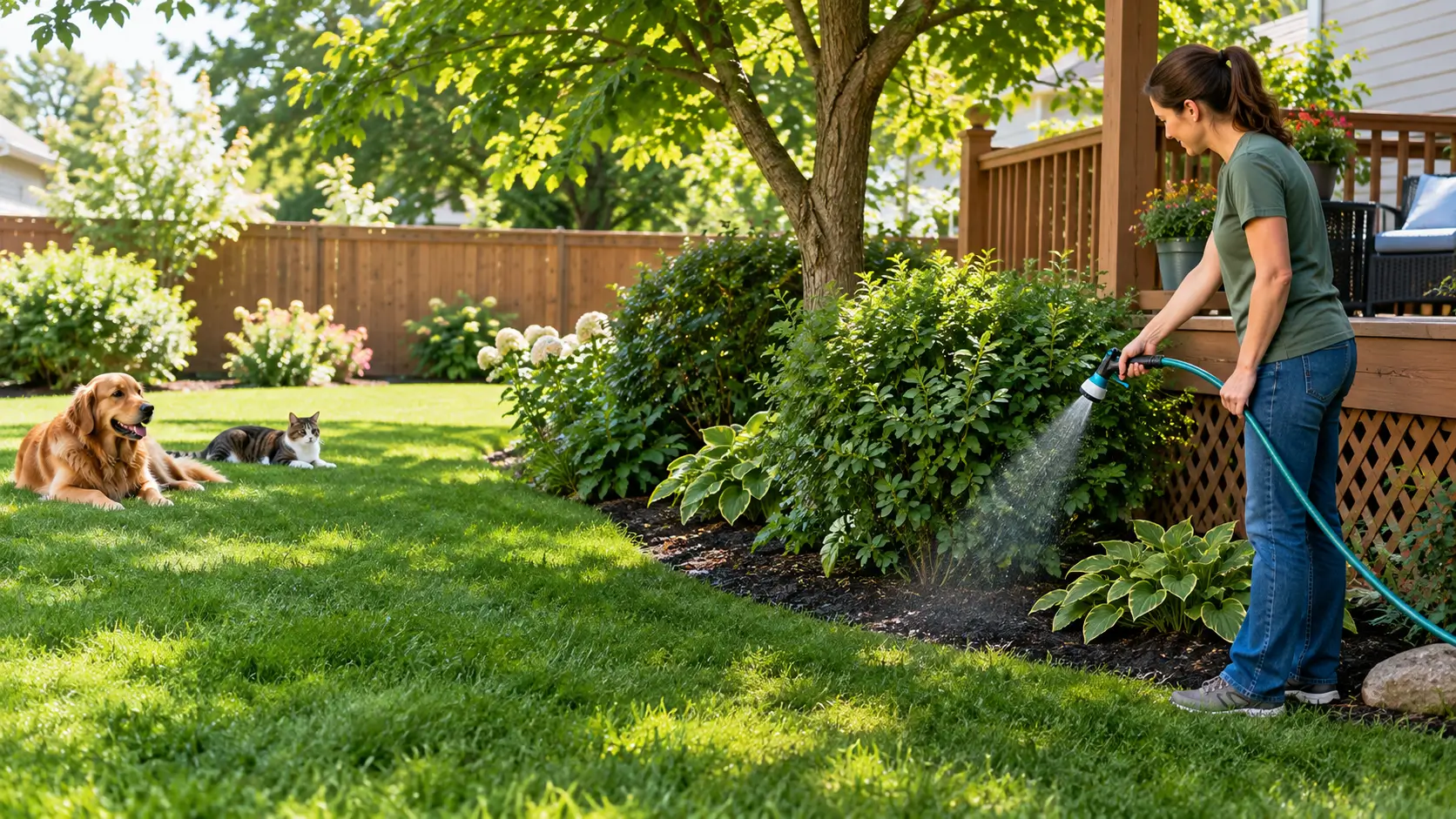
You also may not need to treat the entire yard. Fleas favor protected places such as areas beneath decks, porches, shrubs, doghouses, and other locations where animals spend time. Sunny, open lawn usually offers poorer conditions for flea development.
This guide explains how to choose an outdoor flea treatment, where to apply it, what ingredients to look for, what mistakes to avoid, and when professional help makes more sense.
What Is a Flea Killer for Yard Safe for Pets?
A pet-conscious yard flea killer is an outdoor flea-control product that carries directions for the intended area and provides specific precautions for people and animals.
The important word is label. No pesticide should get a blanket “safe for pets” label from a general article. The product label determines where you can use it, which pests it targets, how you apply it, and when pets can return.
What makes a yard treatment a better choice?
Look for these features:
- The label specifically lists fleas as a target pest.
- The label allows outdoor or yard use.
- The label gives clear instructions for keeping pets away.
- The product identifies its active ingredients.
- The manufacturer provides clear first-aid and exposure instructions.
- The treatment fits your yard rather than requiring unnecessary broad spraying.
An insect growth regulator, or IGR, may also help. Products containing pyriproxyfen can interfere with flea development, including immature stages. Some outdoor flea-control programs use this type of ingredient in areas where fleas develop.
Quick Facts Box
| Fact | Details |
| Main pest | Fleas |
| Main outdoor risk area | Shaded, moist places where pets rest |
| Whole-lawn spraying | Often unnecessary |
| Useful ingredient category | Insect growth regulators, depending on label |
| Common outdoor IGR | Pyriproxyfen in some labeled products |
| First safety step | Read the complete product label |
| Pet access | Follow the label’s re-entry instructions |
| Best overall approach | Treat pets and flea-prone environments together |
| Professional help | Useful for persistent or large infestations |
Outdoor flea development depends heavily on the environment. Fleas need suitable shelter, moisture, and access to an animal host. That makes targeted treatment more logical than automatically covering every square foot of grass.
Where Does This Flea-Control Approach Come From?
Targeted flea control comes from basic pest-management principles rather than one special “pet-safe” chemical.
Flea management has shifted toward combining several methods. These include controlling fleas on the animal, cleaning indoor resting areas, improving outdoor conditions, and using pesticides only where needed. Extension and veterinary resources continue to recommend this integrated approach.
Why targeted treatment matters
Fleas do not develop equally well across every part of a property. Protected areas provide better conditions than exposed, sunny grass.
That means a careful inspection should come before spraying. Watch where your pet sleeps, rests, or spends long periods outside.
History and Evolution of Flea Control
Flea control once relied heavily on broad insecticide applications and repeated household spraying.
Modern flea management takes a more targeted approach. Pet treatments, environmental cleaning, and insect growth regulators now give owners more ways to interrupt the flea life cycle.
Veterinary and extension guidance also emphasizes correct product selection. Different products target different flea stages, and some ingredients pose particular risks to certain animals.
The biggest change is simple: control the flea problem at its source instead of automatically treating everything.
Key Characteristics and Care Needs
A good yard flea-control plan has three parts: identify the problem, target flea habitat, and protect pets during treatment.
1. Identify where fleas are active
Look for areas where your pet regularly rests.
Common examples include:
- Under decks
- Beneath porches
- Around doghouses
- Under shrubs
- Along protected fence lines
- Near outdoor bedding
- Shaded areas beside buildings
Veterinary and extension sources identify these protected locations as common outdoor flea-development sites.
2. Improve the yard
Remove excessive leaves, organic debris, and other material that creates damp shelter.
Prune vegetation where practical. Increase sunlight and airflow around pet resting areas.
These changes do not replace flea treatment in every infestation. They simply make the environment less favorable for continued flea development.
3. Treat the pet too
A yard treatment alone cannot solve an active flea infestation if the animal continues carrying adult fleas.
Your veterinarian can recommend an appropriate flea-control product for your pet’s species, age, health status, and other medications.
Never assume that a product intended for dogs works safely on cats. The ASPCA specifically warns about permethrin exposure in cats.
Quick Comparison Snapshot
| Option | Best For | Key Difference |
| Targeted outdoor flea treatment | Flea-prone yard zones | Treats specific outdoor breeding areas |
| Outdoor IGR product | Flea development areas | Targets immature flea stages |
| Yard cleanup and habitat changes | Prevention and light problems | Reduces favorable flea habitat |
| Professional pest treatment | Persistent infestations | Uses trained application and product selection |
No option deserves a universal “safest” label. The right choice depends on the product label, property, pets, infestation level, and local conditions.
Chameleons as Pets Flea Killer for Yard Safe for Pets Reviews
This supplied long-tail phrase does not match the main search intent because it combines chameleon ownership with yard flea control.
For a pet owner who actually keeps a chameleon, extra caution matters. EPA guidance notes that flea and tick products are not marketed specifically for reptiles and other exotic pets, so owners should ask a veterinarian about pest-control concerns involving these animals.
Do not apply a dog or cat flea product to a chameleon. Do not assume that a product safe for mammals is appropriate for reptiles.
If a chameleon lives in an outdoor enclosure, prevent pesticide drift and keep the enclosure away from treated areas. Follow the outdoor pesticide label and consider professional advice before applying chemicals nearby.
Best Chameleons as Pets Flea Killer for Yard Safe for Pets
The phrase above also combines two unrelated topics, so it should not serve as a product-comparison keyword for this article.
For ordinary dog and cat households, focus instead on the flea-control features that matter:
- Correct outdoor use.
- Flea control listed on the label.
- Clear pet exclusion instructions.
- Appropriate active ingredients.
- A treatment plan that targets flea habitats.
For homes with reptiles, birds, rabbits, or other sensitive animals, ask a veterinarian about environmental pesticide exposure before treatment.
What Should You Look for in a Pet-Conscious Yard Flea Treatment?
The active ingredient matters, but it does not tell the whole safety story.
Check the complete label before buying or applying anything.
Look for an outdoor-use label
A product designed for indoor surfaces does not automatically belong on a lawn or garden.
The label should specifically explain outdoor application. It should also identify the target pests and permitted application sites.
Check the active ingredient
Some outdoor flea products use insect growth regulators. Pyriproxyfen appears in products intended to disrupt flea development and has applications in outdoor flea-control programs.
That does not mean every pyriproxyfen product works in every yard. Formulation and label instructions still matter.
Check the pet restrictions
Read the section covering pets, children, re-entry, and treated surfaces.
The EPA recommends removing pets from pesticide application areas and keeping them away until the product dries or until the label gives a longer waiting period.
How to Treat a Yard for Fleas Without Exposing Pets Unnecessarily
Start with inspection rather than spraying.
Walk through the yard and identify places where your pet rests. You can also use the white-sock method described by university extension resources to help detect adult fleas in suspected areas.
Then follow this sequence:
Step 1: Treat the pets
Speak with your veterinarian about an appropriate flea-control product.
Treating the environment without addressing the animal often leaves the flea cycle intact.
Step 2: Clean outdoor resting areas
Remove leaves, grass debris, and clutter from areas where fleas may find shelter.
Wash removable outdoor bedding according to its care instructions.
Step 3: Identify flea hotspots
Focus attention under decks, shrubs, porches, doghouses, and other shaded resting locations.
Step 4: Apply the selected product
Use only the amount and method specified on the label.
Do not increase the concentration because you want faster results.
Step 5: Keep pets away
Follow the label’s re-entry instructions exactly.
Never let pets walk through a wet pesticide application simply because the product claims to be pet-friendly after drying.
Step 6: Monitor
Flea control may take persistence because different flea life stages respond differently to treatment. ASPCA notes that clearing an infestation may require patience rather than a single overnight treatment.
How Long Should Pets Stay Away From a Treated Yard?
There is no single waiting time that applies to every outdoor flea product.
The product label controls the re-entry period. Some labels may use drying as a condition, while others may provide a specific number of hours or additional restrictions.
Keep pets, children, toys, food bowls, and other sensitive items away from treated areas according to the label. The EPA specifically recommends removing pets from pesticide application areas and keeping them away until the product dries or as otherwise directed.
If you cannot find clear re-entry instructions, do not guess. Contact the manufacturer or choose a product with clearer directions.
Are Natural Flea Treatments Safer for Pets?
“Natural” does not automatically mean safe.
Essential oils and botanical ingredients can still cause problems if animals inhale, ingest, or contact concentrated products. A natural product also needs a label that supports the intended use.
Avoid homemade mixtures that lack reliable safety instructions.
UC IPM also notes that several popular flea-repellent ideas lack good evidence, including herbal collars and ultrasonic devices.
For a yard treatment, a properly labeled product used according to directions gives you clearer safety information than an untested homemade spray.
What About Diatomaceous Earth?
Diatomaceous earth sometimes appears in flea-control advice, but outdoor conditions can limit its usefulness.
The material works through physical effects rather than the same insecticidal action as conventional pesticides. Moisture can reduce its effectiveness, and airborne dust creates an inhalation concern.
Texas A&M guidance notes that outdoor diatomaceous-earth products can require reapplication when wet or exposed to humid conditions.
Do not dust your pet directly unless the specific product label allows that use.
Can You Treat the Whole Lawn?
Usually, broad lawn treatment does not make sense unless the product label and pest situation specifically support it.
Fleas favor protected, shaded areas rather than large expanses of sunny lawn. Veterinary guidance specifically cautions that spraying a large, shade-free lawn often provides little benefit.
Targeting flea hotspots can reduce unnecessary pesticide use.
That approach also makes your cleanup and monitoring easier.
Daily Care Routine / How to Get Started
A simple routine can help prevent another flea cycle.
Weekly yard routine
- Remove leaves and organic debris.
- Check shaded pet-resting areas.
- Wash outdoor pet bedding when appropriate.
- Inspect beneath decks and shrubs.
- Watch your pet for scratching or excessive grooming.
- Keep outdoor feeding areas clean.
- Reduce shelter that attracts wildlife around the property.
Wild animals can contribute to outdoor flea problems. UC IPM recommends limiting food, water, and shelter that attract animals such as feral cats, opossums, squirrels, and coyotes.
During an active infestation
Coordinate your approach instead of treating one location randomly.
Your veterinarian can recommend pet treatment. Your household routine should address indoor resting areas. Your yard treatment should focus on confirmed or likely outdoor flea habitats.
Cost Breakdown
Flea-control costs vary widely by product, property size, infestation level, and whether you hire a professional.
DIY treatment
A homeowner may spend less when treating a small area with a labeled ready-to-use product.
However, the cheapest bottle does not always provide the best value. A poorly matched product can waste money and delay control.
Professional treatment
Professional service costs more upfront but may make sense for large properties, repeated infestations, or owners who cannot safely apply pesticides.
Ask the company which products it plans to use. Request the active ingredients and the pet re-entry instructions.
Veterinary treatment
Pet treatment creates another cost category.
Do not skip it simply because you already treated the yard. Flea control works better when you address the animal and environment together.
Common Mistakes Pet Owners Make
Spraying the entire yard
Most fleas do not need every blade of grass treated.
Target the shaded areas where fleas actually develop.
Ignoring the pet
Adult fleas spend much of their life on the animal.
Treating the yard alone may allow the cycle to continue.
Using a dog product around cats
This can create a serious safety problem. Some dog flea products contain permethrin, which can be dangerous to cats.
Mixing several flea products
Do not combine products casually.
The ASPCA advises against using multiple flea medications on a pet unless a veterinarian directs you to do so.
Using more product than the label allows
More pesticide does not mean better control.
Follow the label exactly.
Letting pets return too early
Even a product marketed for pet households can create exposure if you ignore its re-entry directions.
Trusting “natural” claims without checking
Safety depends on the actual ingredient, concentration, route of exposure, and intended use.
Pros and Cons
| Pros | Cons |
| Targeted treatment can reduce unnecessary spraying | Some infestations need repeated control |
| IGRs can disrupt immature flea development | They may not provide instant adult-flea control |
| Habitat cleanup reduces favorable flea conditions | Cleanup requires ongoing effort |
| Professional treatment can help with persistent problems | Professional service costs more |
| Treating pets and the yard together addresses multiple flea stages | Pet treatments require species-specific selection |
Similar Options and Alternatives
| Option | Best For |
| Pet-only flea prevention | Homes where outdoor flea exposure remains low |
| Yard habitat cleanup | Prevention and mild outdoor flea pressure |
| Targeted outdoor pesticide | Confirmed flea hotspots |
| Professional pest control | Persistent or widespread infestations |
| Veterinary flea-control plan | Pets with active infestations or special health needs |
| Integrated flea management | Recurring problems involving pets, home, and yard |
The best alternative to yard spraying may sometimes be better flea prevention on the pet.
Your veterinarian can help determine whether the flea problem actually requires environmental pesticide treatment.
When to Consult a Vet or Professional
Contact your veterinarian if your pet has persistent scratching, hair loss, skin irritation, weakness, or other concerning symptoms.
Young animals can face greater problems from significant flea infestations. ASPCA notes that heavy flea blood loss can contribute to anemia, especially in young puppies and kittens.
Ask a veterinarian before using flea medication on a pet that is pregnant, nursing, sick, very young, elderly, or taking other medications.
Professional pest control may help when fleas keep returning despite appropriate pet treatment and environmental cleaning.
If pesticide exposure occurs, follow the product’s first-aid instructions and contact a veterinarian promptly. Keep the original product container or label available so professionals know exactly what was used.
Fun Facts
- Adult fleas spend much of their lives on an animal host.
- Flea eggs and immature stages can develop in the environment.
- Fleas favor protected, moist, shaded outdoor locations.
- Pet bedding can become an important flea habitat.
- Flea pupae can survive inside protective cocoons.
- Insect growth regulators target flea development rather than simply acting as adult-killing pesticides.
- Sunny, exposed lawn generally provides poorer flea-development conditions.
- Wildlife can contribute to outdoor flea problems around homes.
Frequently Asked Questions
What kills fleas in the yard safe for pets?
No outdoor pesticide should receive a blanket “safe for pets” label without considering its exact formulation and directions. The safer choice involves an outdoor flea product whose label specifically permits yard use, followed exactly as written. Target shaded flea habitats rather than automatically spraying the whole lawn. Keep pets away during application and for the label’s stated re-entry period. Also treat the pets themselves with veterinarian-approved flea control when needed. EPA guidance stresses that pesticide safety depends heavily on correct use, label directions, and precautions.
Do fleas hate the smell of chamomile?
There is not enough reliable evidence to recommend chamomile scent as a dependable way to control a yard flea infestation. A pleasant-smelling plant or homemade spray should not replace proven flea-management steps. Flea control works better when you address the animal host, indoor resting areas, and outdoor flea habitats together. Be especially careful with concentrated essential oils around pets because “natural” does not automatically mean harmless. If you want to use a botanical product, check that its label specifically allows the intended use around your animals. For persistent flea problems, ask your veterinarian about an established prevention plan.
What kills fleas but not pets?
There is no single substance that you can safely treat as universally harmless to every pet. Dogs, cats, reptiles, birds, rabbits, and other animals can have different sensitivities to pesticides. For example, the ASPCA warns that permethrin products intended for dogs can cause severe poisoning in cats. The safer strategy involves selecting a product for the correct species and using it exactly according to its label. For environmental treatment, choose only products labeled for the specific location and pest. If several pet species share your home, ask a veterinarian before treatment.
What permanently kills fleas?
No single yard treatment guarantees permanent flea elimination. Fleas have several life stages, and environmental conditions can allow the population to return. A better goal involves breaking the flea life cycle over time. Treat affected pets, clean their resting areas, improve flea-prone outdoor habitats, and use targeted environmental treatment when appropriate. Flea pupae can remain protected from some treatments, so adult fleas may continue emerging after an initial application. Persistent control therefore requires monitoring rather than assuming one spray finished the job.
Can fleas live in sunny grass?
Fleas generally favor protected areas rather than large, exposed areas of sunny grass. Shaded and moist locations around decks, porches, shrubs, doghouses, and pet resting areas provide more suitable conditions. That does not mean every sunny lawn is automatically flea-free. Your pet’s behavior and local conditions still matter. This is why inspection helps before treatment. Concentrating control on likely flea habitats can reduce unnecessary pesticide application and make the treatment plan more focused.
Should I treat my house and yard at the same time?
Sometimes, but not every flea problem requires simultaneous pesticide treatment indoors and outdoors. If your pet keeps bringing fleas inside, your veterinarian may recommend treating the animal while you clean bedding, rugs, carpets, and resting areas. Outdoor treatment becomes more relevant when fleas continue developing where the pet spends time outside. ASPCA recommends addressing the environment when necessary, especially when pets become repeatedly reinfested. The exact approach depends on where fleas are active and how severe the infestation is.
Final Thoughts
A safe flea-control plan starts with a simple idea: treat the flea problem, not every inch of your property.
Inspect the yard first. Look for shaded, moist places where your pet spends time. Clean those areas and reduce the shelter fleas need. If pesticide treatment makes sense, select an outdoor product labeled for fleas and follow every safety instruction.
Most importantly, do not separate yard control from pet care. Adult fleas can remain on animals while eggs and immature stages develop in the environment. Treating only one side of that cycle can leave you chasing the problem.
If your home includes cats, dogs, reptiles, or other animals, species-specific safety matters. When you are unsure about a product, ask your veterinarian before using it.
The goal is not simply a flea-free lawn. It is a practical flea-control routine that protects your pets while avoiding unnecessary pesticide exposure.

Sophia Bennett is an animal care contributor at PetJournalHub. She writes educational articles about companion animals, pet wellness, training, and daily care. She believes that trustworthy information helps every pet owner build a healthier and happier life for their pets.