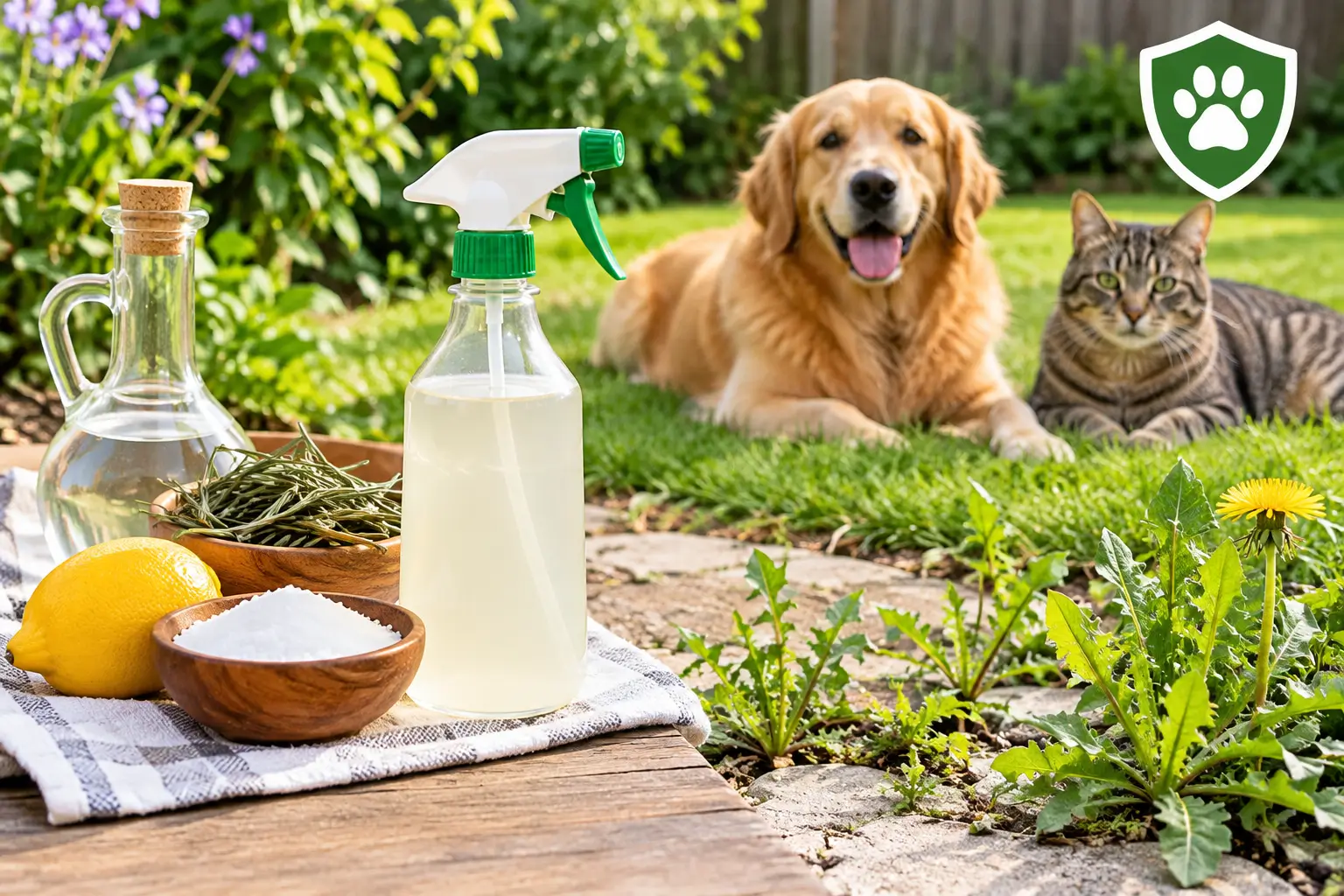
A homemade weed killer safe for pets is a DIY weed-control mix made from household ingredients that won’t poison a dog or cat if they walk on or lick the treated area. The safest versions skip salt and rely on vinegar, dish soap, or boiling water, plus keeping pets off the lawn until it dries.
Key Takeaways
- A homemade weed killer safe for pets usually means vinegar-based, salt-free, and applied when pets can be kept off the area until it dries.
- Salt is the ingredient to watch — it’s the main reason some “natural” recipes aren’t actually pet-friendly.
- Horticultural vinegar (20%+) works faster than plain white vinegar but needs more careful handling around pets and skin.
- Cost is low: most recipes use items already in your kitchen, usually under $10 per batch.
- Always let treated grass or soil dry fully before letting pets back outside.
- When in doubt about a symptom after exposure, call your vet or the Pet Poison Helpline right away.
Introduction
Pet owners search for a homemade weed killer safe for pets for one simple reason: they don’t want a dandelion problem turning into a vet bill. Store-bought herbicides often carry warnings about keeping kids and animals off the lawn for a day or more, and that’s enough to make a lot of dog and cat owners nervous.
This is a real everyday problem, not a passing trend. Anyone with a yard and a curious dog runs into it eventually. Weeds pop up between patio stones, along fence lines, and in garden beds — right where a dog likes to sniff or a cat likes to nap.
The good news is you don’t need a mystery chemical to fight back. A few kitchen ingredients, used the right way, can knock out weeds without putting your pet at risk. This guide walks through what actually works, what to skip, and how to apply it so your yard stays weed-free and your pet stays safe.
What Is Homemade Weed Killer Safe for Pets?
A homemade weed killer safe for pets is a DIY mix that kills or weakens weeds using common household items instead of commercial herbicides. The goal is to avoid ingredients that are toxic if a pet steps in them, licks their paws, or eats treated grass.
Most pet-safe DIY recipes lean on three main ingredients: white vinegar, dish soap, and sometimes boiling water. Vinegar’s acetic acid dries out the leaves of the weed, dish soap helps the mix stick to the leaf surface, and boiling water works purely through heat.
What makes a recipe “pet safe” isn’t just the ingredient list — it’s also how you apply it. Even a gentle mix can cause stomach upset if a pet drinks pooled liquid or eats a soaked weed right after spraying. Letting the area dry, and rinsing splash zones on patios or walkways, matters as much as the recipe itself.
Quick Facts Box
| Fact | Details |
| Main safe ingredients | White vinegar, dish soap, boiling water |
| Ingredient to avoid or limit | Salt (linked to sodium ion poisoning in pets) |
| Typical cost per batch | Under $10 using pantry staples |
| Best time to apply | Sunny, dry day with no rain forecast for 24 hours |
| Wait time before letting pets back out | Until the area is fully dry to the touch |
| Works best on | Young weeds, cracks in pavement, garden edges |
Key Characteristics of a Truly Pet-Safe Weed Killer
A recipe earns the “pet safe” label when it avoids ingredients pets shouldn’t ingest, dries fast, and doesn’t leave a residue that lingers on paws or fur.
What to Look For
- No salt, or only a very small, well-diluted amount used sparingly on hardscape (not lawn areas pets walk on)
- Uses food-grade or standard white vinegar, not industrial-strength chemical blends
- Applied with a spray bottle for control, not poured freely where pets can reach it
- Dries within a few hours in sun
What to Avoid
Some “natural” weed killer recipes still include borax or heavy salt concentrations. Both can cause vomiting, diarrhea, or worse if a pet eats enough. This can vary depending on your pet’s size and how much they’re exposed to, so it’s best to confirm any recipe with your vet or check with the ASPCA Animal Poison Control Center if you’re unsure.
Quick Comparison Snapshot
| Option | Best For | Key Difference |
| Vinegar + dish soap spray | Small weeds in cracks and beds | Fast-acting, low cost, dries within hours |
| Boiling water | Patio and driveway weeds | No chemicals at all, but less effective on deep roots |
| Vinegar + salt + dish soap | Tough, established weeds | Stronger kill power, but salt raises pet-safety concerns |
| Commercial pet-safe herbicide | Larger lawns, ongoing weed control | Consistent results, costs more than DIY |
Homemade Weed Killer Safe for Pets Without Vinegar
If your dog tends to graze on grass, you might want an option that skips vinegar’s strong smell and acidity altogether. Boiling water is the simplest vinegar-free method. Pour it directly onto the weed’s base on a dry, sunny day.
This works especially well in driveway cracks and along walkways where you’re not worried about surrounding plants. It won’t work as well on established weeds with deep roots, so expect to repeat the treatment every couple of weeks.
Another vinegar-free option some gardeners use is a strong dish soap and water mix sprayed directly on leaves. It’s gentler and slower, but it avoids the vinegar smell entirely, which some pet owners prefer if their dog likes to lick nearby plants.
Homemade Weed Killer Safe for Pets Vinegar
Vinegar is the backbone of most DIY weed control, and it can be used safely around pets with the right precautions. Standard white vinegar (5% acetic acid) is milder than horticultural vinegar, which can run 20% or higher.
For a pet-conscious approach, mix one gallon of white vinegar with a tablespoon of dish soap in a spray bottle. Spray weed leaves directly on a sunny afternoon. The acid breaks down the leaf’s waxy coating, and the sun does the rest.
Keep pets off the sprayed area until it’s completely dry, usually a few hours. Vinegar in small amounts is unlikely to cause serious harm, but a pet lapping up puddled spray could still end up with an upset stomach.
Best Homemade Weed Killer Safe for Pets
Out of the common DIY options, the vinegar and dish soap spray (without salt) tends to be the best overall balance of effectiveness and pet safety. It kills young weeds within a day or two and doesn’t leave behind a substance that’s dangerous if licked once dry.
For tougher weeds, some pet owners add a small amount of citrus oil instead of salt, since it boosts the mix’s strength without the sodium risk. This can vary depending on the plant and soil type, so results aren’t always consistent — reapplication is normal.
If you want more predictable results on a bigger area, a commercial herbicide labeled as pet-safe once dry is worth comparing against the DIY route, especially for lawns rather than small garden beds.
Pet Friendly Weed Killer Recipe Vinegar
Here’s a straightforward pet-friendly recipe built around vinegar:
- 1 gallon white vinegar (5%)
- 1 tablespoon liquid dish soap
- Optional: 1 cup water to dilute for sensitive garden areas
Mix everything in a spray bottle or pump sprayer, shake gently, and apply directly to weed leaves on a dry, sunny day. Avoid spraying near plants you want to keep, since vinegar doesn’t tell weeds apart from flowers.
Skip the salt in this version if pets have access to the treated area. It’s the extra step that keeps this recipe firmly in pet-friendly territory instead of just “natural.”
Strong Homemade Weed Killer
Sometimes a mild recipe just doesn’t cut it against crabgrass or thistle with deep roots. For a stronger mix, gardeners often reach for horticultural vinegar at 20-30% acetic acid instead of the standard 5% kitchen version.
This concentration works faster and kills tougher weeds in one application, but it’s also more irritating to skin, eyes, and paws while wet. Treat it the way you’d treat any strong chemical: gloves for you, and no pet access until the area dries completely.
Because horticultural vinegar is more corrosive, keep it away from areas pets frequently lie down in, like shaded patio corners or garden edges near a dog bed.
3 Ingredient Homemade Weed Killer
The classic “3 ingredient” recipe circulating online is vinegar, salt, and dish soap. It’s popular because it’s cheap and effective — but salt is exactly the ingredient that makes it a poor fit for yards where pets roam freely.
If you want a 3-ingredient mix that’s actually pet-friendly, swap salt for a splash of lemon juice instead. You’ll still get vinegar, dish soap, and a citrus boost, minus the sodium risk. It won’t be quite as aggressive as the salt version, but it’s a safer trade for households with dogs or cats.
Save true salt-based recipes for isolated hardscape spots pets never reach, like a gravel driveway edge, and even then, apply sparingly.
Strong Homemade Weed Killer Without Vinegar
For pet owners who want serious weed-killing power without vinegar’s acidity, boiling water combined with repeated applications is the main non-chemical option. It’s not glamorous, but consistency makes it effective over a few weeks.
Another route is a strong dish soap concentration — around a quarter cup per gallon of water — sprayed directly and left in full sun. The soap breaks down the weed’s outer layer, causing it to dry out faster than a diluted mix would.
Neither option matches horticultural vinegar for speed, but both avoid any acid or salt exposure entirely, which some pet owners prefer for total peace of mind.
Pet Safe Weed Killer Home Depot
This one leans more commercial than the rest of this list, so here’s the short version for pet owners specifically: Home Depot carries several herbicide brands labeled safe for pets and kids once the product has fully dried, usually listed on the front label or safety data sheet.
Always read the label directly rather than assuming “natural” or “organic” wording means zero risk to pets. Look for clear reentry times — how long you need to keep pets off the treated area — and follow them exactly, the same way you would with a DIY recipe.
If a product doesn’t list a reentry time, that’s a good reason to call the manufacturer or choose a different brand.
How to Get Started With a Pet-Safe DIY Application
Getting started takes less prep than most people expect. Here’s the basic process:
- Choose a sunny day with no rain in the forecast for 24 hours.
- Mix your chosen recipe in a spray bottle or pump sprayer.
- Keep pets indoors or in a separate area during application.
- Spray weed leaves directly, avoiding wanted plants.
- Let the area dry completely — check by touching a treated leaf.
- Rinse any hard surfaces like patios where liquid pooled.
- Let pets back outside once everything is dry.
Reapply every one to two weeks for stubborn weeds, since homemade mixes don’t have the staying power of commercial products.
Cost Breakdown
DIY weed killer is one of the cheapest yard projects you can take on. A gallon of white vinegar runs about $3-5, and dish soap you likely already own. A full batch typically costs under $10 and covers a decent-sized garden bed or several cracks in pavement.
Horticultural vinegar costs more, often $15-25 per gallon, but treats a larger area per application since it’s more concentrated. Commercial pet-safe herbicides range widely, often $15-40 per bottle depending on brand and coverage area.
Common Mistakes Pet Owners Make
A few habits turn a safe recipe into a risky one:
- Spraying right before letting the dog out, without waiting for it to dry
- Using the salt-and-vinegar recipe on lawn areas pets walk across daily
- Leaving puddled mix on patios or driveways where a pet can lap it up
- Assuming “natural” automatically means “harmless” in any amount
- Storing homemade mixes in unlabeled containers pets or kids could get into
Most of these come down to timing and storage, not the recipe itself.
Pros and Cons
| Pros | Cons |
| Cheap and uses items already at home | Weaker than commercial herbicides on tough weeds |
| No mystery chemicals or long safety data sheets | Needs more frequent reapplication |
| Easy to control application by hand | Salt-based versions carry real pet-safety risk |
| Fast to mix and use same-day | Can also kill wanted plants if oversprayed |
Similar Options and Alternatives
| Option | Best For |
| Manual weeding by hand or tool | Small yards, garden beds, pet owners who prefer zero chemicals |
| Landscape fabric or mulch | Preventing new weeds before they sprout |
| Corn gluten meal | Pre-emergent weed prevention that’s generally considered low-risk for pets once watered in |
| Pet-safe commercial herbicide | Larger lawns needing consistent, longer-lasting control |
When to Consult a Vet or Professional
If your pet licks, walks through, or eats any part of a treated area — homemade or store-bought — and starts showing symptoms like vomiting, drooling, lethargy, or diarrhea, contact your veterinarian right away. Don’t wait to see if it passes on its own.
This is especially true for anything involving salt, since symptoms of sodium ion poisoning can escalate quickly. Keep the product or recipe on hand so you can tell your vet exactly what was used.
For lawn care questions beyond basic weed control, like large-scale infestations or persistent invasive species, a licensed lawn care professional can advise on options that also account for pet safety.
Fun Facts
- White vinegar’s acetic acid works by drawing moisture out of a plant’s leaves, essentially drying it to death.
- Horticultural vinegar is roughly four to six times stronger than the vinegar in your kitchen pantry.
- Dish soap in weed killer recipes isn’t there to kill weeds — it just helps the liquid stick instead of rolling off.
- Boiling water is one of the oldest weed control tricks, used long before modern herbicides existed.
- Corn gluten meal was originally studied as an animal feed ingredient before gardeners discovered its weed-prevention properties.
- Not all weeds respond the same way to vinegar; broadleaf weeds tend to react faster than grassy ones.
Frequently Asked Questions
How to make homemade weed killer pet friendly? Stick with white vinegar and a small amount of dish soap, and leave out salt entirely if pets have access to the area. Mix one gallon of vinegar with a tablespoon of dish soap, spray directly on weeds, and keep pets away until it’s fully dry. This basic swap — dropping salt — is the single biggest change that makes a recipe genuinely pet friendly rather than just homemade.
Is vinegar weed killer harmful to pets? Standard 5% white vinegar is considered low-risk for pets in small amounts, though it can still cause mild stomach upset if a pet drinks a puddle of it. Stronger horticultural vinegar (20% or higher) is more irritating to skin and eyes while wet. The real safety step is timing: keep pets off treated areas until everything has dried, regardless of vinegar strength.
What is the best way to kill weeds without harming my pets? The most reliable pet-safe approach combines vinegar and dish soap for young weeds, boiling water for cracks and pavement, and manual pulling for anything in a bed where pets nap or dig. Rotating these methods based on the weed type usually beats relying on one recipe alone, and none of them require keeping pets indoors for more than a few hours.
Does vinegar, salt, and dawn really kill weeds? Yes, this classic combination is effective, sometimes more effective than vinegar alone, because salt disrupts a plant’s water balance on top of vinegar’s acid damage. The tradeoff is that salt lingers in soil and can pose a real risk if pets eat treated soil or drink runoff. If pets share the yard, it’s worth using this mix only on isolated hardscape areas they can’t reach.
Do I need to worry about my cat if I only treat the front yard? If your cat has any outdoor access to that area, treat it the same as you would for a dog: keep her inside until the treated spot is fully dry. Cats groom their paws constantly, so any residue gets ingested quickly, making dry time just as important for cats as for dogs.
Final Thoughts
Keeping a yard weed-free doesn’t have to mean choosing between a tidy lawn and a safe space for your pet. The right homemade weed killer safe for pets comes down to two things: picking a recipe without salt, and giving it time to dry before your dog or cat goes back outside.
Start small, test a recipe on a corner of the yard, and watch how it performs before treating everything at once. If you ever notice unusual symptoms after your pet spends time outdoors, don’t guess — a quick call to your vet is always the safer move.
With a little patience and the right mix, you can keep the dandelions down without ever putting your pet at risk.

Emily Carter is a pet care writer at PetJournalHub. She enjoys creating clear, practical, and well-researched articles about pet health, nutrition, grooming, and everyday care. Her goal is to help pet owners make informed decisions through reliable, easy-to-understand content.