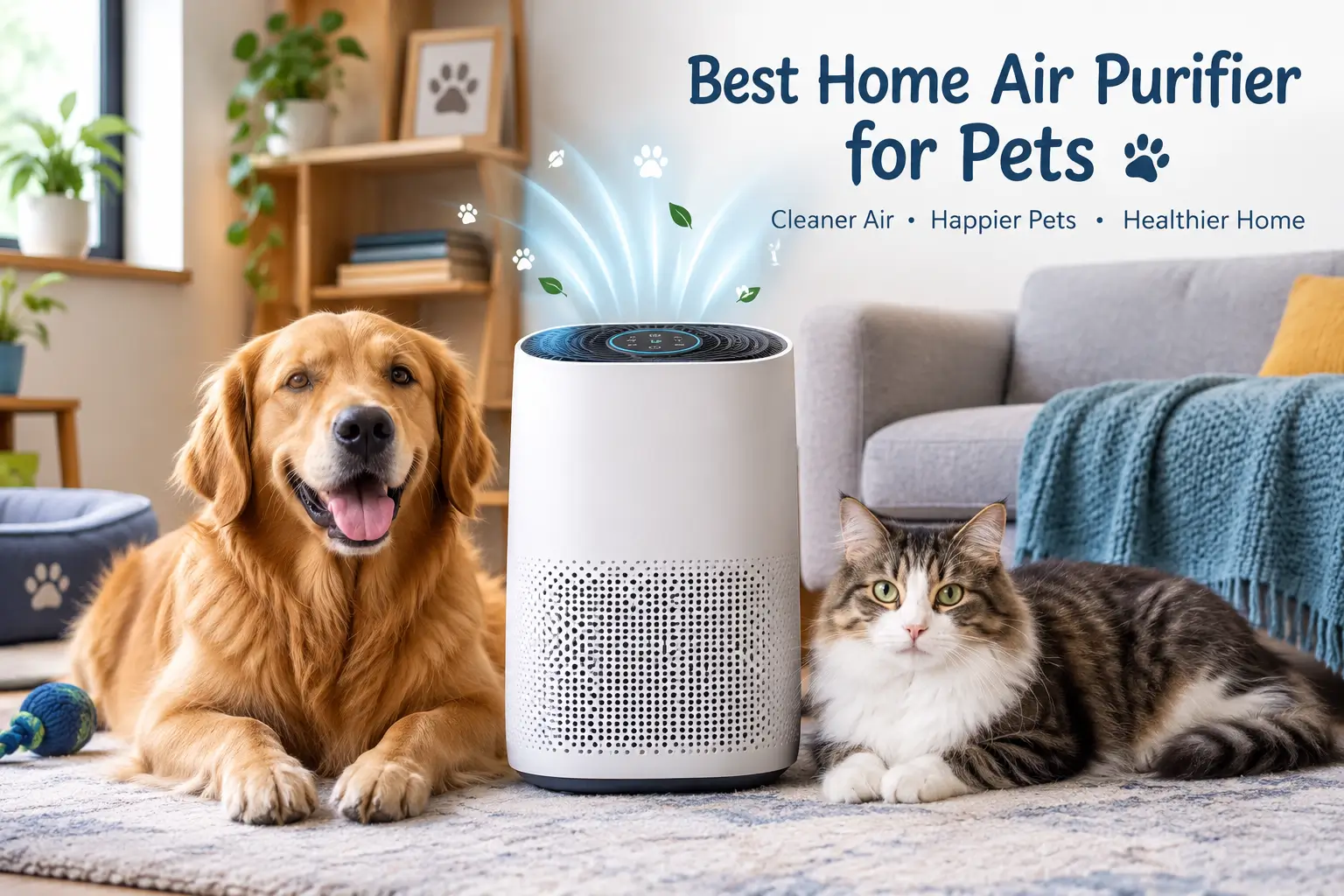
A good pet-home air purifier uses efficient particle filtration, enough airflow for the room, and optional activated carbon for odors. Look for a properly sized unit with a useful CADR, easy filter maintenance, and safe operation around people and animals. An air purifier works best alongside grooming, vacuuming, cleaning, and good ventilation.
Key Takeaways
- Choose filtration based on pet dander, dust, hair, or odor, because each needs a different approach.
- Match the purifier’s CADR and room coverage to the space where your pet spends time.
- HEPA or high-efficiency mechanical filtration helps capture airborne particles.
- Activated carbon can help with some pet and household odors.
- A washable pre-filter can help manage larger particles from shedding pets.
- Avoid air cleaners that intentionally generate ozone around people or pets.
- In Pakistan, check replacement-filter availability before buying an imported model.
- Air purification supports cleaning routines but does not replace grooming, vacuuming, or veterinary care.
Introduction
Living with pets brings companionship, but it also brings fur, dander, dust, pollen, and odors into the home. Some of those particles settle on floors and furniture. Others remain airborne long enough for a purifier to capture them.
That difference explains why many dog and cat owners start looking for an air purifier. They want cleaner indoor air without giving up the pets they love.
The challenge comes from choosing the right machine. A purifier designed for a small bedroom may struggle in a large living room. A strong particle filter may help with dander but do little for odors without activated carbon. A cheap appliance may also become expensive if replacement filters are difficult to find.
For Pakistani pet owners, the buying decision can involve another layer. Local dust, seasonal air pollution, electricity use, imported prices, warranty coverage, and filter availability can all affect long-term value.
This guide explains what matters before you spend money. It covers HEPA filtration, CADR, carbon filters, pet hair, dander, odors, washable filters, allergy concerns, and practical use.
The goal is simple: help you choose a purifier that fits your home instead of choosing one because the package says “pet.”
What Is the best home air purifier for pets?
The phrase refers to a portable air-cleaning device selected specifically for a home with companion animals. There is no single model that fits every pet household.
A useful pet-home purifier should handle airborne particles while offering enough airflow for the room. Many pet owners also benefit from activated carbon when odors matter.
The EPA explains that portable air cleaners work as a supplement to source control and ventilation. They cannot remove every pollutant from indoor air.
For pet owners, the main targets usually include:
- Airborne pet dander
- Fine dust
- Pollen
- Smoke particles
- Some airborne fur and fibers
- Certain odor-causing gases when carbon filtration exists
Large pieces of fur require a different strategy. Vacuuming and grooming work better for hair that has already settled.
HEPA filters also need context. The EPA describes HEPA as a pleated mechanical filter that can theoretically remove at least 99.97% of particles at 0.3 microns under specified test conditions. That does not mean every purifier removes 99.97% of every pollutant in a home.
Actual results depend on airflow, filter condition, room size, placement, and operating time.
Quick Facts Box
| Fact | Details |
| Main purpose | Reduce certain airborne particles and pollutants |
| Main pet target | Airborne dander and fine particles |
| Particle filtration | HEPA or another high-efficiency mechanical filter |
| Odor control | Activated carbon can help with some gases and odors |
| Room sizing | Check CADR and manufacturer coverage |
| Pet hair | Vacuuming works better for settled hair |
| Filter care | Follow the manufacturer’s cleaning and replacement instructions |
| Safety | Avoid intentionally ozone-generating products |
| Best results | Combine filtration with cleaning and ventilation |
Key Characteristics / Care Needs
The right purifier depends on the problem you want to solve. Start with the room size, then look at filtration, airflow, maintenance, noise, and filter costs.
HEPA filtration
HEPA is a type of mechanical filtration. It uses dense filter material to capture airborne particles.
For pet households, this matters because dander and fine dust can remain suspended in indoor air. Consumer Reports also identifies pet dander, dust, and other household particles among the pollutants HEPA-equipped air purifiers can capture.
Do not confuse particle filtration with complete home cleaning. Once allergens settle onto furniture, carpets, bedding, or floors, you still need normal cleaning.
Activated carbon
Carbon serves a different job from a particle filter.
Activated carbon can adsorb certain gases and odor compounds. That makes it useful when litter-box smells, wet-fur odors, cooking smells, or other household odors concern you.
The amount of carbon matters. A thin carbon layer may offer less odor capacity than a filter containing a larger quantity of carbon material.
CADR
CADR stands for Clean Air Delivery Rate.
It helps show how much filtered air a purifier delivers. A higher CADR generally suits a larger space.
The EPA provides room-size guidance based on CADR and notes that higher fan speeds and longer operating times increase the amount of air filtered.
Do not buy based only on a large square-foot number printed on the box. Check the actual CADR and the room-size guidance.
Pre-filters
A pre-filter catches larger particles before they reach the main filter.
That can matter in homes with shedding dogs or cats. Some models use washable pre-filters, which can make routine maintenance easier.
However, only wash a component if the manufacturer identifies it as washable.
Noise
A purifier can run for many hours, so noise matters.
Some pets ignore the sound. Others may react to a new appliance. Start a nervous pet at a lower setting and allow the animal to approach the machine naturally.
Never place bedding or furniture against the air intake simply to reduce noise.
Quick Comparison Snapshot
| Option | Best For | Key Difference |
| Levoit Vital 200S-P | Pet hair, dander, and larger rooms | Washable pre-filter, pet-focused airflow design, carbon filtration |
| Levoit Core 400S-P | Larger rooms and smart controls | 231 CFM CADR with particle and odor filtration |
| Coway AP-1512HH Mighty | Medium-to-large room use | HEPA and carbon filtration with auto mode |
| Blueair Blue Pure 211i Max | Large rooms | High airflow with HEPA and activated carbon filtration |
These options represent different feature sets rather than a universal ranking. Current manufacturer and Consumer Reports information shows meaningful differences in room coverage, filtration, airflow, controls, and maintenance.
The Levoit Vital 200S-P includes a washable pre-filter, main particle filter, and activated carbon stage. The manufacturer also describes a U-shaped air inlet designed to capture airborne pet fur. The Core 400S-P lists a 231 CFM CADR and carbon support for household odors.
Consumer Reports lists the Coway AP-1512HH Mighty as a large-room purifier and the Blueair Blue Pure 211i Max as a large-room model. Blueair lists a 435 CFM smoke CADR for the 211i Max. Exact room ratings can differ by testing method, so compare the manufacturer’s specifications with independent testing when available.
Best home air purifier for pets in pakistan
For Pakistani pet owners, filter availability deserves almost as much attention as the purifier itself.
A machine can look affordable when you buy it. The real cost appears later when the main filter needs replacement.
Local conditions also vary. Homes may face indoor dust, outdoor pollution, seasonal smog, traffic-related particles, and different ventilation patterns.
Before buying, check these points:
- Room size: Measure the room where your pet spends the most time.
- CADR: Compare airflow instead of relying only on advertised coverage.
- Replacement filters: Search for the exact model number.
- Filter price: Calculate expected yearly maintenance.
- Warranty: Confirm whether local support exists.
- Voltage: Check the exact electrical requirements for imported models.
- Noise: Consider whether your pet reacts strongly to appliances.
A purifier imported from another country may work well but still create maintenance problems if filters become unavailable.
For that reason, local replacement-filter access should form part of your buying decision.
Best air purifier for pets and dust
For homes dealing with both pets and dust, prioritize strong particle filtration and adequate airflow.
A pre-filter can help catch larger hair, lint, and fibers. The main filter then handles smaller airborne particles.
The key distinction is where the dust sits.
Dust on a floor does not automatically move into the purifier. Vacuuming removes settled material more effectively. Air filtration helps with particles that remain suspended.
If outdoor dust enters through doors or windows, source control matters too. Cleaning entryways, improving ventilation when outdoor air quality allows, and keeping pet bedding clean can reduce the overall load.
For a dusty home, check how easy the pre-filter is to access. Frequent maintenance becomes much easier when you can remove and clean the component without taking apart the whole machine.
Best air purifier for pet allergies and asthma
A properly sized purifier with high-efficiency particle filtration may help reduce airborne particles in an allergy-sensitive home.
The American Lung Association recommends air cleaners as one part of reducing exposure to pet dander. It also emphasizes keeping pets out of allergy-sensitive bedrooms and cleaning surfaces frequently.
An important limitation remains: allergens do not stay in the air.
Pet allergens can settle on bedding, carpets, furniture, clothing, and other surfaces. A purifier cannot clean those surfaces for you.
If someone has diagnosed asthma or significant allergies, follow their clinician’s treatment plan. Do not treat an air purifier as a replacement for prescribed care.
The same safety principle applies to pets. If a dog or cat shows persistent coughing, breathing difficulty, repeated sneezing, unusual nasal discharge, or other concerning symptoms, contact a veterinarian.
Best air purifier for pets with washable filter
A washable pre-filter can make sense for homes with heavy shedding.
It catches larger debris before that material reaches the main filter. That can simplify maintenance and help protect airflow.
But the term “washable filter” can cause confusion.
Some products have a washable pre-filter but a disposable main filter. Never wash the main filter unless the manufacturer specifically approves washing it.
For example, the Levoit Vital 200S-P lists a washable pre-filter that captures lint, fibers, hair, and pet fur. Its main filter handles smaller airborne particles, while activated carbon targets odors and other gases.
Maintenance should follow the exact manual for your model. Pet homes can load filters faster than low-dust households.
Best air purifier for pet odor
Odor control requires a different filter strategy from dander control.
HEPA filtration targets particles. Activated carbon targets certain gases and odor compounds.
That means a purifier with only particle filtration may not address strong pet smells very well.
Still, an air purifier should not become an odor-covering machine. If a litter box smells, clean the litter area. If pet bedding smells, wash it. If a pet develops a sudden unusual odor from the ears, skin, mouth, or coat, ask a veterinarian about the cause.
For persistent household odors, look for a purifier with a meaningful carbon stage.
The EPA notes that carbon filters can help filter gases, but performance depends on the design and amount of carbon material.
Air purifier for pet hair and dust
Pet hair and airborne dust need different solutions.
A purifier may capture some airborne fibers and small particles. It cannot replace a vacuum for fur sitting on the floor, sofa, rug, or pet bed.
Heavy shedders benefit from a routine that combines grooming, vacuuming, and filtration.
Place the purifier where your pet spends significant time. Keep the intake and exhaust areas clear. Do not push the machine into a corner where furniture blocks airflow.
For open-plan homes, one small purifier may not provide enough airflow across the entire space. You may need a larger unit or multiple room-specific units.
The EPA recommends considering the entire area served by a portable air cleaner, especially in open floor plans.
Best affordable air purifier for pets
Affordable should mean affordable to own, not just cheap to purchase.
Start with the room size. Buying an undersized purifier can lead to poor results and constant high-speed operation.
Then calculate ongoing filter costs.
A simple ownership calculation looks like this:
Purchase price + replacement filters + electricity + shipping or service costs
A purifier with a washable pre-filter may reduce some maintenance expenses. However, the main filter may still require replacement.
Smart features also affect price. Wi-Fi, apps, air-quality displays, and automatic modes can add convenience, but they do not replace adequate filtration and airflow.
For a tight budget, spend first on the fundamentals:
- Suitable CADR
- Effective particle filtration
- Reasonable filter cost
- Reliable replacement-filter access
- Safe operation
- Appropriate room coverage
Levoit air purifier for pet hair
Levoit offers several models aimed at homes with pets, including the Vital 200S-P and Core P350-P.
The Vital 200S-P specifically includes a washable pre-filter, a main particle filter, and activated carbon filtration. Its U-shaped air inlet is designed to help capture airborne pet fur.
The Core 400S-P provides a different setup for larger spaces. Levoit lists a 231 CFM CADR for that model and describes carbon filtration for household and pet odors.
These specifications make the two models useful examples of how pet-focused features differ.
Do not choose between models based only on the word “pet.” Compare room size, airflow, filter availability, noise, and ownership cost.
Daily Care Routine / How to Get Started
An air purifier works best as part of a simple pet-home cleaning routine.
Step 1: Choose the main room
Start with the room where your pet spends the most time.
That might be the living room, bedroom, office, or a dedicated pet area.
Step 2: Measure the space
Measure the length and width of the room.
For an open-plan area, consider the entire connected space rather than measuring one small section.
Step 3: Match the purifier
Compare your room size with the manufacturer’s specifications and CADR.
Do not assume a purifier designed for a small room can handle an entire floor.
Step 4: Position it correctly
Keep the intake and outlet clear.
Avoid placing the machine directly behind curtains, furniture, or other objects that restrict airflow.
Step 5: Build a pet-cleaning routine
Brush your pet according to its coat and grooming needs.
Vacuum floors and furniture regularly. Wash pet bedding according to the material and manufacturer’s instructions.
Clean litter areas frequently.
Step 6: Maintain the purifier
Clean the washable components according to the manual.
Replace disposable filters when the manufacturer recommends it or when the unit’s filter indicator calls for replacement.
Step 7: Monitor your pet
Watch how your pet reacts to the appliance.
If your pet appears stressed by the noise, give it time to adjust and use a quieter setting when practical.
Cost Breakdown
Air purifier costs fall into more than one category.
| Cost | What to Check |
| Machine | Initial purchase price |
| Main filter | Replacement price and expected interval |
| Pre-filter | Whether cleaning or replacement is required |
| Carbon filter | Replacement cost if separate |
| Electricity | Wattage and daily operating time |
| Shipping | Especially important for imported models |
| Warranty | Local repair or replacement support |
Consumer Reports’ current air-purifier coverage shows that annual filter and electricity costs can vary significantly between models.
That makes ownership cost more useful than purchase price alone.
For Pakistani buyers, also check whether sellers stock genuine replacement filters. A machine that requires an imported filter can become harder to maintain later.
Prices change often, so use current local listings as a snapshot rather than a permanent cost.
Common Mistakes Pet Owners Make
Buying for visible hair only
Visible fur looks like the biggest problem, but an air purifier mainly deals with airborne material.
Ignoring room size
A purifier cannot compensate for inadequate airflow simply because its package says “pet.”
Expecting HEPA to remove every odor
Particle filters and carbon filters perform different jobs.
Forgetting replacement filters
Always investigate filter availability before purchasing.
Using ozone generators
Avoid products that intentionally produce ozone in occupied spaces. The EPA identifies ozone as a lung irritant and advises against ozone-generating air cleaners in occupied spaces.
Stopping normal cleaning
A purifier does not replace grooming, vacuuming, litter-box cleaning, or washing pet bedding.
Washing a non-washable filter
Follow the manufacturer’s instructions. Some filters can handle water. Others cannot.
Blocking the purifier
Do not cover the intake or outlet with furniture, fabric, or pet bedding.
Pros and Cons
| Pros | Cons |
| Can reduce some airborne pet particles | Does not remove settled allergens from surfaces |
| HEPA filtration can capture fine particles | Filters need regular maintenance |
| Carbon can help with some odors | Carbon capacity varies by product |
| Useful alongside cleaning | Cannot replace grooming or vacuuming |
| Portable models can target one room | Large homes may need multiple units |
| Smart controls can simplify operation | Smart features can increase purchase price |
| Washable pre-filters can simplify pet-hair maintenance | Main filters may still require replacement |
Similar Products / Alternatives
These options provide different approaches rather than repeating the four models above.
| Option | Best For |
| HVAC filter upgrade | Homes with central forced-air systems |
| Portable HEPA purifier | One bedroom, office, or pet-heavy room |
| Multi-room purifier setup | Larger homes with separate living areas |
| Activated-carbon purifier | Homes where odor control matters |
| Purifier with washable pre-filter | Heavy-shedding pets |
| DIY air cleaner | Temporary budget situations when commercial units are unavailable |
| MERV-rated HVAC filtration | Whole-home particle filtration where the system supports it |
The EPA recommends choosing an HVAC filter with at least MERV 13, or as high as the system can accommodate, when upgrading central filtration.
Do not install a filter that your HVAC system cannot handle. If you’re unsure, ask an HVAC professional or check the equipment manufacturer’s specifications.
When to Consult a Vet or Professional
An air purifier supports the indoor environment. It does not diagnose or treat a pet illness.
Contact a veterinarian if your pet develops:
- Persistent coughing
- Breathing difficulty
- Repeated sneezing
- Unusual nasal discharge
- Sudden skin problems
- Significant changes in normal breathing
- Other symptoms that concern you
Do not assume that dust or pet dander caused a symptom.
Respiratory and skin problems can have many causes. A veterinarian can assess the animal and recommend appropriate care.
For household members with asthma or serious allergies, speak with a physician or allergy specialist. Filtration can form part of an environmental-control plan, but medical care should come from a qualified professional.
Fun Facts
- HEPA stands for high-efficiency particulate air.
- Pet allergens are not limited to visible fur.
- Allergens can settle on furniture, carpets, clothing, and bedding.
- Particle filters and carbon filters serve different purposes.
- CADR measures the delivery of filtered air.
- Large pieces of pet hair often settle before a purifier can capture them.
- Air purifiers cannot remove every indoor pollutant.
- Filter maintenance affects airflow and performance.
Frequently Asked Questions
What is the best air purifier for a house with pets?
There is no single purifier that fits every house with pets. Room size, CADR, filter type, odor concerns, maintenance costs, and replacement-filter access all affect the choice.
A smaller bedroom may need a compact unit. A large open living area needs substantially more airflow. A home with strong pet odors may also benefit from a larger activated-carbon stage.
For Pakistani buyers, local filter availability deserves special attention. Before buying, search for the exact replacement filter model and confirm that sellers can supply it.
Do air purifiers really work with pets?
Yes, they can reduce certain airborne particles, including airborne dander and fine dust. Their effect depends on the purifier, room size, airflow, filter condition, placement, and operating time.
They do not remove everything related to pets.
Once dander, hair, or dust settles on a sofa or floor, vacuuming and surface cleaning become more important. Grooming also helps manage loose hair before it spreads around the home.
Think of an air purifier as one layer of a larger cleaning system. It works alongside grooming, vacuuming, bedding care, litter management, and appropriate ventilation.
What removes pet dander from air?
High-efficiency mechanical filtration, including HEPA filtration, can capture airborne particles such as pet dander.
The challenge is that pet allergens do not stay airborne permanently. Some settle on furniture, carpets, bedding, and clothing.
That means an effective strategy combines air filtration with regular cleaning. Vacuum floors and furniture, wash pet bedding as appropriate, and clean areas where your pet spends significant time.
The American Lung Association also recommends reducing exposure through measures such as keeping pets out of allergy-sensitive bedrooms and using air cleaners as part of exposure control.
What is the best air purifier for pets according to Consumer Reports?
Consumer Reports does not provide one permanent, pet-specific model that applies to every household. Its air-purifier testing evaluates factors such as dust, pollen, and smoke removal, noise, ease of use, and other characteristics.
Its current buying guidance notes that HEPA-equipped air purifiers can capture common airborne irritants, including pet dander. Consumer Reports also maintains model-specific testing pages, and its ratings can change as products and test results change.
For pet owners, use those independent results alongside room size, CADR, carbon filtration, filter cost, and local replacement-filter availability.
Can an air purifier replace vacuuming when you have pets?
No. Air purification and vacuuming target different parts of the indoor environment.
A purifier works on airborne particles. A vacuum removes material that has settled on floors, rugs, furniture, and other surfaces.
This distinction matters because larger pieces of pet hair often settle quickly. Dander can also collect on surfaces after becoming airborne.
A practical pet-home routine combines both tools. Vacuum areas where your pet rests, clean bedding regularly, groom according to the animal’s needs, and use the purifier to address particles that remain suspended in the air.
Should an air purifier run all day with pets?
The ideal schedule depends on the purifier, room, pet activity, indoor air quality, and household needs.
Longer operation generally means the machine filters more air. Many current models also offer automatic modes that adjust fan speed based on detected particles.
A properly sized purifier running at a moderate setting can make more sense than a tiny purifier running at maximum speed.
Check the manufacturer’s operating guidance and filter-maintenance instructions. If the filter becomes loaded with dust and fur, airflow can drop.
Are ozone air purifiers safe around pets?
Avoid intentionally ozone-generating air cleaners in occupied spaces.
The EPA describes ozone as a lung irritant and advises avoiding portable air cleaners that intentionally produce ozone. Some electronic technologies may also have ozone-emission concerns.
For a home with pets, people, and other occupants, mechanical particle filtration offers a more established approach to particle removal.
If a product uses ionization, plasma, UV, or another electronic technology, check its ozone-emission information carefully rather than assuming every air-cleaning technology works the same way.
Final Thoughts
Choosing an air purifier for a pet home becomes easier when you stop looking for one magic feature.
Start with the room. Then check CADR and filtration. If dander and dust matter most, focus on high-efficiency particle filtration. If odors matter, look for meaningful activated-carbon filtration. If your pet sheds heavily, a useful pre-filter can make maintenance easier.
Do not forget the long-term costs. Replacement filters, electricity, local availability, and warranty support can matter more than a small difference in the purchase price.
Most importantly, treat the purifier as part of pet care rather than a replacement for it. Grooming, vacuuming, clean bedding, litter-box care, sensible ventilation, and regular veterinary attention all remain important.
For Pakistani pet owners, the safest buying habit is simple: confirm the exact model, check the room rating, verify replacement filters, and avoid products that intentionally generate ozone.
A well-matched purifier can support cleaner indoor air. The right choice depends on your home, your pet, and the problem you are actually trying to solve.

Emily Carter is a pet care writer at PetJournalHub. She enjoys creating clear, practical, and well-researched articles about pet health, nutrition, grooming, and everyday care. Her goal is to help pet owners make informed decisions through reliable, easy-to-understand content.