Featured Snippet Answer:
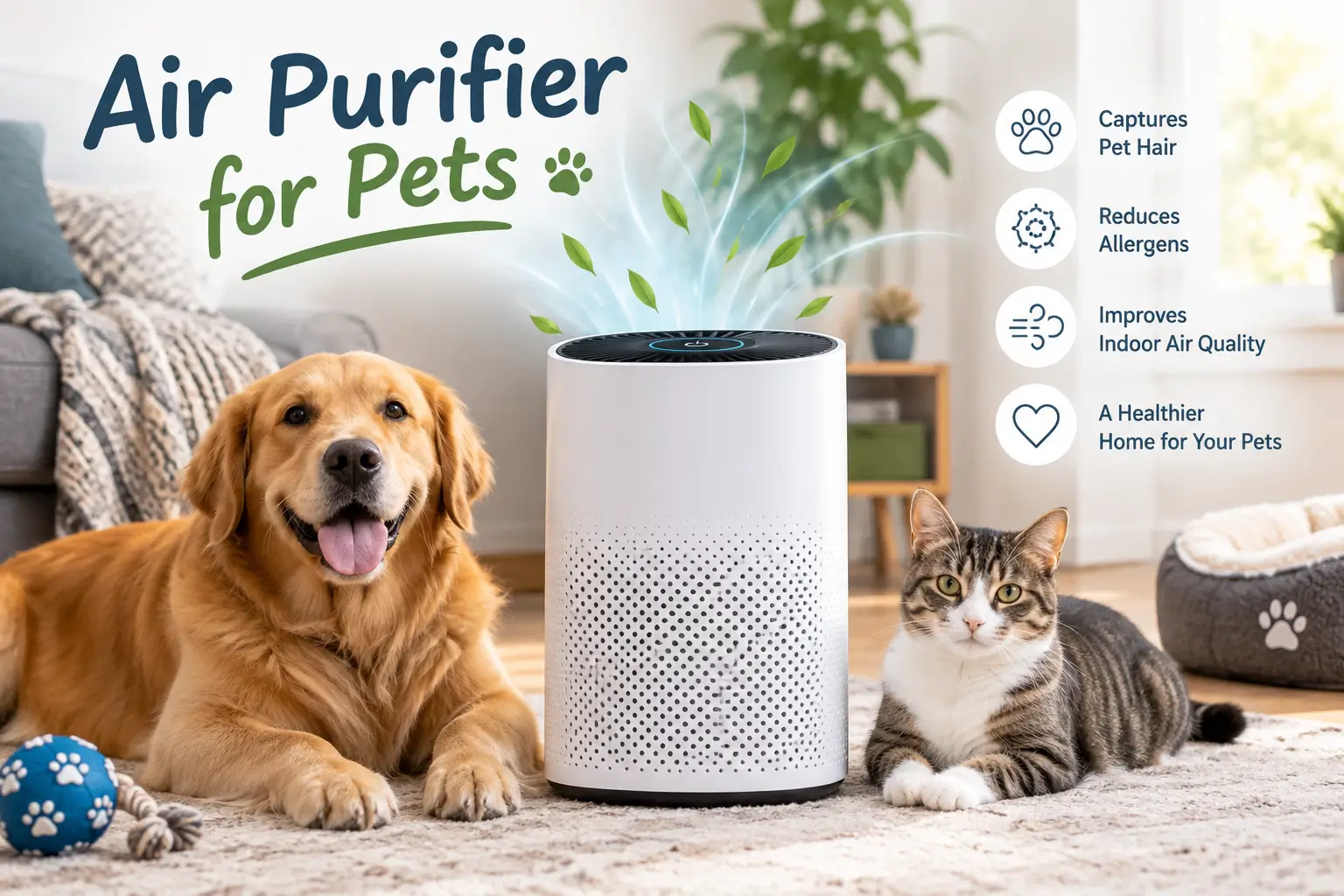
Air purifier pets refers to choosing and using an air purifier in a home with dogs, cats, or other companion animals. A suitable unit can help capture airborne pet dander, dust, pollen, and some odors. Look for strong particle filtration, suitable room coverage, manageable filter costs, and pet-safe operation without intentional ozone generation.
Key Takeaways
- Pet hair, dander, dust, and odors need different cleaning approaches.
- A HEPA-style particle filter helps capture airborne particles.
- Activated carbon can help with household and pet-related odors.
- CADR matters because larger rooms need stronger airflow.
- Air purification works best alongside grooming, vacuuming, and ventilation.
- Avoid products that intentionally generate ozone around people or pets.
- Check replacement-filter availability before buying an imported purifier.
- Allergy or breathing problems in a pet need veterinary attention, not just cleaner air.
Introduction
Living with a dog or cat brings plenty of joy, but it also brings fur, dander, dust, and sometimes stubborn odors. These particles can collect on floors, furniture, bedding, and other surfaces. Some also become airborne when pets move, scratch, shake, groom themselves, or play.
That explains why many pet owners search for an air-cleaning solution. The right purifier can reduce some airborne particles in the room. However, it cannot replace brushing, bathing, vacuuming, litter-box care, or regular cleaning.
Another common misunderstanding involves pet hair. Large clumps of fur usually settle quickly on floors and furniture. A purifier works mainly on particles that remain suspended in the air. Pet dander and smaller particles therefore matter more when choosing a machine.
For households in Pakistan, the decision can also involve outdoor dust, seasonal smog, electricity use, replacement-filter availability, and local prices. Imported machines may look attractive until the replacement filter becomes difficult to find.
This guide explains what to look for, how to size a purifier, how to use it around pets, and which features deserve your money. It also separates genuine filtration benefits from marketing claims.
What Is air purifier pets?
For pet owners, an air purifier is a portable filtration device designed to clean air within a room or defined indoor area. It pulls room air through filters, captures some pollutants, and sends filtered air back into the room.
The most useful setup for a pet household usually combines particle filtration with odor control. A mechanical filter handles airborne particles, while activated carbon can help adsorb some gases and odors.
Pet-related pollutants can include:
- Airborne dander
- Fine dust
- Pollen brought indoors
- Small airborne hair particles
- Smoke and other household particles
- Some odor-causing compounds
The important distinction is simple: a purifier cleans the air, not the entire home.
The EPA notes that portable air cleaners work best as a supplement to source control and ventilation. They also cannot remove every pollutant from indoor air.
Quick Facts Box
| Fact | Details |
|---|---|
| Main purpose | Reduce certain airborne pollutants |
| Most useful pet target | Airborne dander and fine particles |
| Particle filter | HEPA or another high-efficiency mechanical filter |
| Odor support | Activated carbon |
| Room sizing | Check CADR and manufacturer room guidance |
| Large pet hair | Vacuuming works better than air filtration |
| Filter care | Follow the manufacturer’s replacement schedule |
| Pet safety | Avoid intentionally ozone-generating products |
| Best results | Combine filtration with cleaning and grooming |
Key Characteristics / Care Needs
The best purifier for a pet home depends on more than the word “pet” on the box. Start with the room size, then examine the filtration system, airflow, filter cost, noise, and safety features.
HEPA filtration
HEPA refers to a type of pleated mechanical filter. The EPA explains that a true HEPA filter can theoretically remove at least 99.97% of particles at 0.3 microns under the stated test conditions.
That does not mean a purifier removes 99.97% of everything in your house. Real-world performance depends on airflow, filter condition, room size, placement, and operating time.
Activated carbon
Carbon serves a different purpose. It can adsorb certain gases and odor compounds.
If pet odor matters to you, look for a purifier with a meaningful carbon layer. A thin carbon coating may offer less odor capacity than a filter containing more carbon material.
CADR
Clean Air Delivery Rate, or CADR, helps compare how quickly a purifier delivers filtered air.
A higher CADR generally suits a larger room. Always compare the purifier’s rated room size with your actual space rather than buying based on appearance alone.
Pre-filters
A washable or cleanable pre-filter can catch larger particles before they reach the main filter. This feature can matter in homes with heavy shedding.
It may also reduce the amount of fur reaching the main filtration stage.
Noise
Pets hear sounds differently from people, and individual animals react differently to household appliances.
If your pet dislikes new machines, start at a lower fan setting and allow the animal to approach the device voluntarily. Never block the purifier’s air intake to reduce noise.
Quick Comparison Snapshot
| Option | Best For | Key Difference |
|---|---|---|
| Xiaomi Smart Air Purifier 4 Lite | Small to medium rooms | Strong local availability in Pakistan |
| Levoit Core 300S | Bedrooms and compact rooms | Compact smart design and pet-focused replacement filter options |
| Coway Airmega Mighty AP-1512HH | Medium rooms | Strong CADR with multiple filtration stages |
| Blueair Blue Pure 211i Max | Large rooms | High airflow and large-room capacity |
These models illustrate different buying priorities rather than a universal winner. Room size, replacement-filter access, noise, budget, and local warranty support can change the right choice for each household.
Air purifier pets pakistan
For Pakistani pet owners, availability matters almost as much as filtration. A purifier that performs well but lacks replacement filters can become expensive or inconvenient over time.
Pakistan also presents different indoor-air challenges depending on the city and season. Dust, traffic pollution, smoke, and seasonal smog can add to the particle load inside a home.
Before buying, check five things:
- Room size: Match the purifier to the room where your pet spends the most time.
- Replacement filters: Confirm that genuine compatible filters are available locally.
- Filter price: Calculate the yearly replacement cost.
- Voltage and warranty: Imported units may require extra attention here.
- Noise: Check whether the machine works quietly enough for your pet’s normal routine.
Xiaomi currently lists several air-purifier models through its Pakistan site, including the Smart Air Purifier 4 Lite. Local listings also show several Xiaomi models and replacement filters.
Do not assume that a model sold internationally will have easy local support. Check the exact model number before ordering.
Air purifier pets price in pakistan
Prices in Pakistan vary widely by brand, room capacity, smart features, import costs, and filter availability. A low purchase price does not always mean a low ownership cost.
For example, current Pakistani listings show Xiaomi models ranging from compact units to much larger premium machines. Local retailers also list Royal and Philips models at different price levels.
Instead of choosing from the sticker price alone, calculate the total cost:
Purchase price + replacement filters + electricity + possible shipping or service costs.
A cheaper purifier can become less attractive if replacement filters cost a lot or disappear from local stores.
Prices also change frequently. Treat online prices as a snapshot rather than a permanent market rate.
Air purifier pets price
A useful budget approach divides purifiers into three groups.
Entry-level
These units usually suit bedrooms, offices, or smaller pet areas. They can work well when the room has a modest particle load.
Mid-range
Mid-range models often provide stronger airflow, better sensors, larger filters, or improved smart controls.
Premium
Premium units may offer higher airflow, larger coverage, better sensors, more sophisticated controls, or specialized filtration.
The important question remains: Does the purifier clean your actual room at a useful rate?
Paying extra for an oversized machine makes little sense if you only need it for a small bedroom. On the other hand, an undersized purifier may struggle in a large open living area.
Best air purifier for pet hair
A purifier can help with airborne particles associated with shedding, but it will not replace a vacuum or brush.
Large pieces of pet hair often settle before a portable purifier can capture them. This makes a strong pre-filter useful, but regular floor cleaning remains essential.
For heavy shedders, look for:
- A washable or easy-clean pre-filter
- Strong airflow
- High particle CADR
- A sealed or well-designed filtration system
- Affordable replacement filters
- Easy access for maintenance
Your cleaning routine matters too. Brush your pet according to its coat and grooming needs. Vacuum floors, furniture, and pet sleeping areas regularly.
The purifier should serve as one part of that system.
Best air purifier for pet allergies and asthma
People with allergies or asthma often focus on airborne particles, but a purifier should not become the only control measure.
Pet allergens can settle on furniture, bedding, carpets, clothing, and other surfaces. An air purifier can address particles that remain airborne, while cleaning and source control address the rest.
A particle-focused purifier with high-efficiency filtration may help reduce airborne particles. Activated carbon may also help with some odors.
If someone in the home has diagnosed asthma or serious allergies, follow their clinician’s treatment plan. Do not use an air purifier as a substitute for prescribed medical care.
The same principle applies to pets. If a dog or cat develops coughing, wheezing, repeated sneezing, breathing difficulty, or other concerning symptoms, contact a veterinarian.
Best air purifier pets
A suitable purifier for a pet home should match the room and the household problem.
For a small bedroom, a compact unit may provide enough airflow without taking up much floor space. For a large living room, stronger CADR becomes more important.
If odor is the main concern, prioritize a model with a substantial activated-carbon stage. If dander and dust are the priority, focus on particle filtration and airflow.
Smart features can help, but they should come after the basics. A phone app cannot compensate for a purifier that lacks enough airflow for the room.
Air purifier for pet hair and dust
Pet homes often contain a mixture of visible hair and fine dust. These require different cleaning methods.
A vacuum handles settled hair and dust. An air purifier handles particles that remain airborne.
Use the purifier in the room where your pet spends the most time. Keep air intake and outlet areas clear. Avoid placing the machine directly behind furniture or curtains.
For homes with several pets, you may need more than one unit. Another option involves using a central HVAC filter where appropriate.
The EPA recommends considering room size and CADR when choosing a portable air cleaner. Higher fan speeds and longer run times generally increase the amount of air filtered.
Best air purifier for pets with washable filter
A washable pre-filter can make sense for pet owners because it can catch larger particles before they reach the main filter.
However, “washable filter” needs careful reading. Manufacturers may call the pre-filter washable while the main HEPA filter remains disposable.
Never wash a filter unless the manufacturer specifically says you can. Washing a non-washable high-efficiency filter can damage its structure and reduce performance.
Also check how often the washable component needs cleaning. A purifier exposed to heavy shedding may need more frequent attention than one in a low-shedding home.
The Winix 5500-2, for example, uses a washable pre-filter and washable carbon component alongside its main particle filter. Always follow the specific manufacturer’s maintenance instructions.
Daily Care Routine / How to Get Started
Setting up a purifier takes only a few minutes, but placement and routine affect how useful it becomes.
Step 1: Choose the right room
Start with the room where your pet spends the most time.
A bedroom can make sense if your pet sleeps there. A living room may make more sense for a family dog that spends most of the day there.
Step 2: Check the room rating
Measure the room and compare it with the manufacturer’s recommended coverage.
When possible, compare CADR values instead of relying only on vague phrases such as “large room.”
Step 3: Give the purifier space
Keep the intake and outlet unobstructed. Do not push the unit tightly against a wall unless the manual allows that placement.
Step 4: Start with a comfortable fan speed
Let your pet become familiar with the sound.
If your pet seems worried, reduce the speed temporarily and allow the animal to investigate without pressure.
Step 5: Build a cleaning routine
A practical pet-home routine includes:
- Brush the pet according to its coat needs.
- Vacuum floors and furniture regularly.
- Wash pet bedding as appropriate.
- Clean litter areas frequently.
- Empty or clean the purifier’s pre-filter when needed.
- Replace disposable filters according to the manufacturer’s guidance.
Step 6: Watch the filter
Heavy shedding can load filters faster.
Do not wait for a filter to become visibly filthy if the manufacturer provides a replacement schedule or indicator.
Cost Breakdown
The purchase price represents only part of the cost.
A better calculation uses four categories:
| Cost | What to Check |
|---|---|
| Machine | Initial purchase price |
| Main filter | Replacement cost and interval |
| Pre-filter | Whether it can be cleaned or needs replacement |
| Electricity | Wattage and daily operating time |
Filter availability deserves special attention in Pakistan. Before purchasing an imported purifier, search for the exact replacement filter model.
Also check whether the seller offers genuine filters. A compatible-looking replacement may not provide the same fit or filtration performance.
Running a purifier continuously can consume more electricity than occasional use. However, running time also affects how much air the machine actually filters. A useful strategy involves choosing a properly sized unit rather than relying on a tiny purifier at maximum speed.
Common Mistakes Pet Owners Make
Buying for pet hair alone
Pet hair creates an obvious mess, but airborne dander often matters more for air filtration.
Ignoring CADR
A beautiful purifier cannot overcome inadequate airflow for a large room.
Forgetting replacement filters
Always check replacement availability before purchasing.
Expecting odor removal from HEPA alone
HEPA filtration targets particles. Activated carbon handles certain gases and odors.
Using ozone-generating products
Avoid products that intentionally produce ozone in occupied spaces. Ozone can irritate the lungs.
Stopping regular cleaning
A purifier does not vacuum floors, wash bedding, clean litter boxes, or groom pets.
Overlooking placement
Blocking the intake or outlet reduces airflow and limits performance.
Washing every filter
Only wash components that the manufacturer identifies as washable.
Pros and Cons
| Pros | Cons |
|---|---|
| Helps reduce airborne particles | Does not remove every pollutant |
| Can support a cleaner pet-home environment | Does not replace vacuuming |
| Carbon can help with some odors | Filters require ongoing maintenance |
| Many models offer automatic fan modes | Some models cost more to operate |
| Compact models suit bedrooms | Large homes may need multiple units |
| Can complement allergy-control efforts | Results vary by room and pollutant |
Similar Products / Alternatives
The following options solve slightly different household needs.
| Option | Best For |
|---|---|
| HVAC filter upgrade | Homes with central HVAC systems |
| HEPA vacuum | Removing settled pet hair and dander |
| Washable pet bedding | Reducing allergen buildup on sleeping surfaces |
| Grooming tools | Controlling loose coat and shedding |
| Activated-carbon odor filter | Homes where pet odors are a major concern |
| Portable purifier in bedroom | Creating a dedicated cleaner-air zone |
| Portable purifier in living room | Homes where pets spend most of the day |
| Damp microfiber cleaning | Removing settled dust without simply stirring it up |
The strongest approach often combines several of these methods rather than relying on one appliance.
When to Consult a Vet or Professional
An air purifier can support the home environment, but it cannot diagnose or treat a pet’s illness.
Contact a veterinarian if your pet develops persistent coughing, breathing difficulty, unusual nasal discharge, repeated sneezing, unexplained skin problems, or other symptoms that concern you.
Do not assume that every respiratory or skin problem comes from household dust or dander. Pets can develop problems from infections, parasites, allergies, irritants, and other causes.
You should also ask your veterinarian before changing grooming products for a pet with sensitive skin.
If a household member has severe allergies or asthma, consult their physician or allergy specialist. Air filtration can support environmental control, but medical treatment should come from a qualified professional.
Fun Facts
- HEPA stands for high efficiency particulate air.
- Pet allergens are not limited to visible fur.
- Some pet allergens can attach to clothing and furniture.
- Activated carbon and particle filters serve different purposes.
- CADR focuses on the rate at which an air cleaner delivers filtered air.
- Large visible hair often settles before a purifier can capture it.
- A purifier cannot remove every indoor pollutant.
- Regular filter maintenance affects purifier performance.
Frequently Asked Questions
What is the best air purifier for pets and pet owners?
There is no single model that suits every pet household. The right choice depends on room size, shedding level, odor concerns, filter availability, budget, and noise tolerance.
For a small bedroom, a compact purifier with high-efficiency particle filtration may make sense. Larger living rooms need more airflow. Homes with strong pet odors may benefit from a substantial activated-carbon stage.
For Pakistani buyers, replacement-filter availability deserves extra attention. Before purchasing, check the exact model number and confirm that compatible filters remain easy to obtain.
Do air purifiers really help with pet hair and dander?
They can help with airborne particles, including some airborne pet dander. They do not replace vacuuming because much of the hair and dander eventually settles onto floors, furniture, carpets, and bedding.
Think of a purifier as an air-cleaning tool rather than a hair-removal machine.
Regular brushing can reduce loose hair before it spreads around the home. Vacuuming then removes settled material. The purifier handles particles that remain suspended in the air.
That three-part approach works better than expecting one appliance to solve every pet-related cleaning problem.
What type of air purifier is best for homes with pets?
Look for a purifier with strong particle filtration, suitable CADR, and room coverage that matches your space. A pre-filter can also help capture larger particles from shedding pets.
Activated carbon becomes useful when odors matter. However, the amount and design of carbon affect how well a product handles gases and odors.
Avoid intentionally ozone-generating air cleaners around occupied spaces. The EPA identifies ozone as a lung irritant and advises avoiding portable air cleaners that intentionally produce ozone.
Finally, check replacement-filter costs before buying. Long-term maintenance matters just as much as the initial purchase.
Can an air purifier reduce pet odors and allergens?
It can help reduce some airborne particles and certain odor compounds, but it cannot eliminate every source of pet odor or allergen.
A particle filter helps with airborne particles. Activated carbon can adsorb some odor-causing gases. Neither approach replaces cleaning the surface where an odor originates.
If a litter box smells, clean the litter area. If bedding smells, wash it. If a pet develops an unusual odor from its skin, ears, mouth, or coat, speak with a veterinarian rather than masking the smell with an air cleaner.
Source control remains an important part of indoor-air management.
How often should you run an air purifier when you have pets?
There is no single schedule that works for every pet home. The right runtime depends on room size, purifier capacity, indoor particle levels, pet activity, and household needs.
Longer operation generally filters more air than occasional use. Many modern units also include automatic modes that adjust fan speed when sensors detect more particles.
If your pet sheds heavily or your home collects significant dust, consistent operation may make more sense than running the purifier for only a short period.
Follow the manufacturer’s instructions and keep the filter maintained. A clogged filter can reduce airflow and performance.
Final Thoughts
A purifier can become a useful part of a pet-friendly cleaning routine, but it should never carry the whole workload.
Start with the actual problem in your home. If shedding creates the biggest issue, prioritize grooming, vacuuming, and a purifier with strong particle filtration. If odors bother you most, look for meaningful activated-carbon filtration. If allergies matter, combine air cleaning with surface cleaning and professional medical advice where appropriate.
Room size should guide your choice too. A small machine may work well in a bedroom but struggle in a large open living area.
For Pakistani pet owners, filter availability deserves special attention. Check the price and supply of replacement filters before buying the machine.
Most importantly, choose a purifier that fits your household rather than chasing the most expensive feature list. Good pet care comes from several simple habits working together: grooming, cleaning, ventilation, sensible filtration, and veterinary care when something seems wrong.

Daniel Brooks is a pet research writer at PetJournalHub. He specializes in pet behavior, product research, and responsible pet ownership. He focuses on delivering accurate, reader-friendly guides that help pet owners provide the best care for their animals.