Featured Snippet Answer:
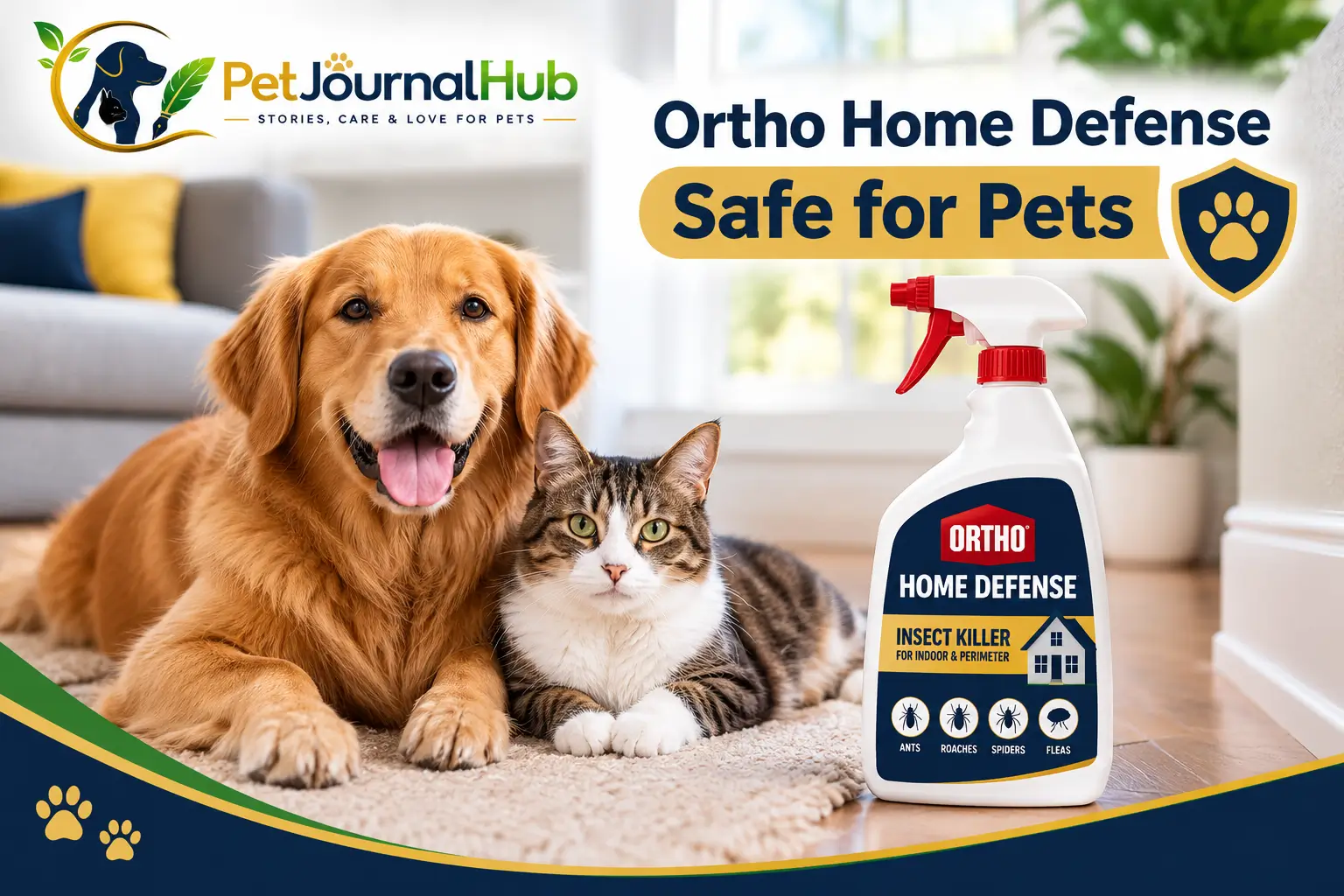
Ortho Home Defense products can be used in homes with pets when the specific product label allows indoor use and you follow every safety direction. Keep pets away during application and until the treated area dries. Remove pet food, water, toys, and bedding before spraying, and never spray the product directly on an animal.
Key Takeaways
- Ortho Home Defense is an insecticide, not a product that owners should treat as harmless around animals.
- The exact formula matters because Ortho sells several Home Defense products.
- For the EPA-registered indoor/perimeter formula reviewed here, the label says people and pets may return after the spray dries.
- Remove pets, bowls, toys, bedding, and exposed food before indoor treatment.
- Never spray Ortho Home Defense directly on your dog, cat, bird, reptile, or other pet.
- If a pet licks or swallows the product, contact a veterinarian or animal poison service promptly.
Introduction
Pet owners often search for ortho home defense safe for pets after spotting ants, roaches, spiders, fleas, or other insects inside the home. The concern makes sense. You want to control pests without turning your pet’s living space into a chemical hazard.
The good news is that the question has a practical answer. Some Ortho Home Defense products carry directions for indoor use around residential spaces. However, “safe for pets” does not mean you can spray while your dog or cat walks around the room.
The product label matters most. Different Home Defense formulas have different active ingredients, application directions, and approved uses. The EPA label for one Home Defense indoor/perimeter formulation lists bifenthrin and zeta-cypermethrin as active ingredients and states that people and pets may re-enter treated areas after the spray dries.
Pet owners also need to think beyond drying time. A curious dog can lick a treated surface. A cat can walk through a wet spray and groom its paws. Birds and aquatic pets may need extra care because some pesticides pose particular risks to these animals.
This guide explains how to use the product more carefully, what the label actually says, what to do after accidental exposure, and when another pest-control approach may make more sense.
What Is ortho home defense safe for pets?
The phrase refers to whether an Ortho Home Defense insecticide can control household pests while minimizing risk to dogs, cats, and other pets. The answer depends on the exact product, application site, dose, and label directions.
Ortho Home Defense is a family of household insecticides rather than one single chemical formula. EPA records show several Home Defense products and alternate brand names, while Ortho currently lists an indoor insect barrier containing bifenthrin.
For the EPA registration reviewed in this guide, the formula contains 0.05% bifenthrin and 0.0125% zeta-cypermethrin. The label identifies the product for indoor and perimeter use and includes directions for areas such as kitchens, bathrooms, doors, windows, and basements.
That does not make every Home Defense product interchangeable.
Before spraying, compare these details on your bottle:
- Exact product name
- EPA registration number
- Active ingredients
- Indoor or outdoor approval
- Application directions
- Re-entry instructions
- First-aid instructions
- Storage requirements
The EPA advises consumers to read pesticide labels and follow them exactly. It also recommends keeping pets away from treated areas as directed by the label.
Quick Facts Box
| Fact | Details |
| Product category | Household insecticide |
| Main use | Control of listed household insects |
| Pet concern | Wet spray, ingestion, skin exposure, and improper use |
| Indoor use | Depends on the specific product label |
| Re-entry | Follow the exact label; the reviewed EPA label allows entry after drying |
| Direct pet application | Do not spray animals |
| Active ingredients in reviewed formula | Bifenthrin and zeta-cypermethrin |
| Best safety rule | Remove pets and their supplies before treatment |
The exact formulation matters. EPA records show that Home Defense products can have different ingredient combinations and registration numbers, so never rely on the brand name alone.
Where Does Ortho Home Defense Come From?
Ortho Home Defense belongs to the household pest-control product category sold for residential insect control. Its modern product line includes formulations designed for indoor, outdoor, or combined indoor-and-perimeter use.
The important point for pet owners is not the brand’s history. It is the specific label attached to the bottle in your home.
EPA registration records identify Ortho Home Defense products under specific registration numbers. Those records also show that formulations can carry alternate brand names.
That explains why online advice sometimes conflicts. One person may own an indoor barrier product while another owns an outdoor perimeter spray. Their directions may differ.
Always use the instructions on your own container.
History and Evolution
Home pest-control products have changed over time as manufacturers developed different formulations, applicators, and target uses.
Older EPA records show earlier Home Defense products with bifenthrin-based formulations. More recent registrations also show products containing combinations such as bifenthrin and zeta-cypermethrin.
This history creates an important lesson for pet owners: old advice can become outdated.
A blog post from several years ago may describe a formula that no longer matches the bottle in your cabinet. The same brand name can also appear on multiple registered products.
For that reason, check the current label every time you use the product.
Key Characteristics / Care Needs
The main safety feature for pet owners is controlled exposure. You want the insecticide on its intended treatment surface, not on your pet, pet food, drinking water, bedding, toys, or skin.
The EPA label reviewed for this guide says the product can treat specific indoor areas and directs users to apply a narrow band along surfaces. It also says people and pets may re-enter after the spray dries.
The National Pesticide Information Center gives similar general guidance. Remove pets and their belongings before treatment, then keep animals away until the pesticide has dried and the area has good ventilation.
Extra care matters for certain animals.
Cats groom their paws and coats, so licking residue can create an ingestion route. Dogs may lick floors, baseboards, or other surfaces. Birds can have greater sensitivity to household fumes, while aquatic animals face special concerns around pesticide runoff.
The reviewed EPA label specifically warns about fish and aquatic organisms and tells users to avoid exposure around ornamental ponds.
Quick Comparison Snapshot
| Option | Best For | Key Difference |
| Ortho Home Defense MAX Indoor Insect Barrier | Indoor recurring insect problems | Designed as an indoor barrier product |
| Ortho Home Defense Indoor & Perimeter RTU | Indoor and perimeter treatment | Ready-to-use format with indoor/outdoor directions |
| Ortho Home Defense concentrate | Larger treatment jobs when label permits | Requires label-directed preparation |
| Non-chemical pest control | Mild or isolated pest problems | Reduces pesticide exposure |
These options do not have identical directions. For example, the EPA registration for a Home Defense indoor/perimeter formulation lists specific active ingredients and approved uses.
Is Ortho Home Defense safe for indoor use
Yes, some Ortho Home Defense products carry indoor-use directions, but safe indoor use depends on the exact label and careful application.
The EPA label reviewed here identifies an indoor/perimeter Home Defense product and gives indoor directions for areas such as kitchens, bathrooms, doors, windows, basements, and pantry cracks.
Before spraying indoors, remove your pets from the treatment area. Take out food bowls, water bowls, toys, chew items, and bedding. Cover or remove exposed food.
Do not spray into the air. Do not soak surfaces. The reviewed label directs users to apply a narrow band and spray surfaces until slightly wet rather than soaking them.
Ventilation also matters. Open windows or use fans when the product label permits it. Keep pets away until the treated area has dried.
For homes with birds, reptiles, amphibians, fish, or pet insects, consider extra caution. ASPCA advises bird owners to consult a veterinarian before applying household insecticides because birds can be particularly sensitive to fumes.
Is Ortho Home Defense safe for humans
Ortho Home Defense should not be treated as harmless simply because it is sold for household use. Follow the product label, avoid unnecessary exposure, and keep people out of the treatment area during application.
The EPA label reviewed here carries a “CAUTION” signal word and warns that the product can harm humans and domestic animals if swallowed. It also notes moderate eye irritation and gives protective clothing instructions for handling.
This distinction matters. A registered household pesticide can have approved residential uses while still requiring careful handling.
After spraying, wash your hands thoroughly. Keep the container closed and stored in its original container.
Do not transfer leftover pesticide into a drink bottle, food container, or another unlabeled vessel. EPA specifically recommends storing pesticides in their original containers and away from children and pets.
Is Ortho home Defense safe for kids
Children should stay away from the treatment area during application and until the label allows them to return.
The EPA recommends removing children, toys, and pets before pesticide application. It also advises keeping them away until the pesticide dries or for the longer period stated on the label.
That rule becomes especially important for crawling toddlers. They spend more time close to floors and may touch baseboards, then put their hands in their mouths.
After treatment, check the area before allowing children or pets back inside. Keep the bottle locked away or otherwise inaccessible.
Never let a child handle the pesticide, even if the container has a child-resistant closure.
Is Ortho Home Defense safe for plants
Do not assume an indoor insecticide is safe for every plant. Plant safety depends on the product, formulation, plant species, and where you apply it.
The EPA label reviewed here gives specific outdoor restrictions and warns against runoff onto plants and other untreated surfaces. It also restricts applications around blooming plants because of risk to bees.
For houseplants, the safest approach is simple: keep them out of the treatment area unless the exact label specifically allows application to those plants.
If spray accidentally lands on a plant, check the product label rather than guessing about toxicity. Plant sensitivity varies widely.
The same rule applies to edible herbs and vegetables. Never apply a pesticide to food crops unless that exact use appears on the label.
Is Ortho Home Defense MAX safe for pets
Ortho Home Defense MAX can have approved residential uses around pets, but “MAX” does not mean every product in the line has identical instructions.
The EPA label for the Home Defense MAX indoor/perimeter formulation reviewed here allows people and pets to return after the spray dries. It also specifically says not to spray animals.
That means pet owners should think in terms of controlled exposure, not zero exposure.
Remove the animal before spraying. Remove its bowls and bedding. Let the treated surface dry. Then follow the label before restoring normal access.
If your bottle has different active ingredients or a different EPA registration number, use that bottle’s instructions instead.
Is ortho home defense safe for pregnant women
The label does not provide a special “safe for pregnancy” guarantee, so avoid unnecessary pesticide exposure during pregnancy and follow the product label closely.
The reviewed EPA label gives handling precautions for people but does not make a pregnancy-specific safety claim.
If a pregnant household member needs to be present during pest treatment, consider having another adult handle the application. Keep the person away from the treatment area during spraying and until the label allows re-entry.
For a pregnancy-specific question, ask the person’s healthcare professional or a poison-information service. Product ingredients, exposure level, ventilation, and application method all affect the situation.
Is Ortho Home Defense good for roaches
Ortho Home Defense products can target cockroaches when the specific product label lists cockroaches among its controlled pests.
The EPA label reviewed for this article lists cockroaches among the home-invading insects covered by the product’s claims.
However, spraying alone does not fix every roach problem.
Pet owners should also reduce food and water sources. Keep pet food sealed when not in use and clean spills quickly. Seal cracks and entry points where practical.
EPA recommends combining prevention with pesticide use. Removing food, water, clutter, and pest hiding places can reduce the need for chemical treatment.
If roaches keep returning despite reasonable control measures, a licensed pest professional can help identify the source.
Ortho Home Defense Indoor
Ortho Home Defense Indoor products focus on household insect control in approved indoor areas. The exact application method depends on the specific bottle and its label.
The current Ortho product page for Home Defense MAX Indoor Insect Barrier lists bifenthrin as its active ingredient and describes indoor applications around areas such as kitchens, bathrooms, doors, windows, and basements.
For pet owners, the important question is not simply whether a product says “Indoor.”
Check whether your exact product allows use on the surface you plan to treat. Then remove pets and their belongings before application.
Never spray food bowls, drinking water, toys, or an animal’s body unless the product specifically carries an approved animal-use direction. The Home Defense label reviewed here explicitly says not to spray animals.
Daily Care Routine / How to Get Started
The safest routine starts before you pick up the sprayer. Treat pest control as a short household project rather than a quick spray-and-forget task.
Before spraying
- Read the entire product label.
- Confirm that your product allows the intended indoor or outdoor use.
- Move pets to a separate, untreated area.
- Remove food and water bowls.
- Remove toys, bedding, chew items, and other pet supplies.
- Cover or remove exposed human and pet food.
- Close or protect aquariums and keep aquatic pets away from possible exposure.
- Open windows or improve ventilation when the label permits it.
NPIC recommends removing pets, toys, bedding, food bowls, and water bowls before pesticide application.
During application
Use only the amount and method stated on the label.
Do not spray an animal. Do not deliberately soak floors or furniture. Avoid food-preparation surfaces unless the label specifically permits the treatment.
The EPA label reviewed here directs users to apply indoor treatment as a narrow band and to spray until slightly wet without soaking.
After spraying
Keep pets and people out until the treated area has dried and the label permits re-entry.
Wash your hands after handling the product. Store the container securely in its original packaging.
If your pet walks across a wet treated area, move the pet away and contact your veterinarian for product-specific advice.
Cost Breakdown
The cost of using Ortho Home Defense depends on the product size, formulation, local retailer, and how much area you need to treat.
Ready-to-use products usually offer convenience because you avoid mixing. Concentrates can make sense for some larger jobs, but they require more attention to label directions.
Your real pest-control cost can also include:
- Replacement bottles or refills
- Protective equipment listed on the label
- Cleaning supplies
- Pest-proofing materials
- Professional pest control
- Veterinary care after accidental exposure
Avoid choosing a pesticide simply because the bottle costs less. A product that does not match your pest problem can lead to repeated applications and more household exposure.
For small pest problems, prevention may cost less over time. Sealing cracks, cleaning food spills, fixing leaks, and reducing clutter can all help limit pest activity. EPA recommends these non-chemical steps as part of safer pest control.
Common Mistakes Pet Owners Make
The biggest mistake is treating “pet-friendly” as a synonym for “risk-free.” Household pesticides still need careful handling.
Other common mistakes include:
- Spraying while pets remain in the room
- Returning pets before the treated surface dries
- Leaving water bowls in the treatment area
- Spraying pet bedding without checking the label
- Applying more product than directed
- Spraying an animal directly
- Mixing products without label instructions
- Using an outdoor-only formula indoors
- Ignoring the EPA registration number
- Storing pesticide where a pet can reach it
- Assuming an old online recommendation matches a newer formula
The EPA states that pesticide use must follow the product label. Using a pesticide in a manner inconsistent with its labeling can violate federal pesticide rules.
Pros and Cons
| Pros | Cons |
| Some formulas carry indoor-use directions | It remains a chemical pesticide |
| Can target several listed household insects | Exact safety depends on the formula and label |
| Ready-to-use options simplify application | Pets must stay away during treatment |
| Drying instructions provide a clear re-entry point | Residue can remain after drying |
| Can fit into a broader pest-control plan | Does not replace pest-proofing or sanitation |
The biggest advantage for pet owners is predictable label guidance. The biggest drawback is the need for careful exposure control.
Similar Products / Alternatives
Different pest-control approaches suit different household problems. The goal is not to use the strongest product available. The goal is to control the pest while limiting unnecessary exposure.
| Option | Best For |
| Sealing cracks and entry points | Preventing ants, roaches, and other insects from entering |
| Cleaning food and water sources | Reducing pest attraction in pet homes |
| Enclosed insect bait stations | Targeted control where pets cannot access the bait |
| Professional integrated pest management | Persistent or widespread infestations |
| Non-chemical traps and exclusion | Small pest problems with low chemical tolerance |
EPA recommends prevention first where practical and notes that enclosed baits can reduce exposure when pets and children cannot access them.
When to Consult a Vet or Professional
Contact a veterinarian if your pet may have swallowed, licked, inhaled, or had significant skin contact with a pesticide.
Do not wait for symptoms before asking for advice if you know an exposure occurred. Product identity, active ingredients, amount, route of exposure, and the animal’s species all matter.
ASPCA recommends contacting a veterinarian or ASPCA Poison Control after suspected toxic ingestion. It also recommends keeping the product name, active ingredients, EPA registration number, and application information available.
A pest-control professional can help when insects keep returning, the infestation covers several rooms, or you cannot safely treat the area yourself.
For birds, pet insects, and some exotic animals, ask your veterinarian before using household insecticides. ASPCA specifically highlights the sensitivity of birds and recommends veterinary guidance.
Fun Facts
- Home Defense is a product family, not one single universal formula.
- EPA registration numbers help identify the exact pesticide product.
- The reviewed indoor/perimeter formula contains bifenthrin and zeta-cypermethrin.
- The reviewed label allows people and pets to return after the spray dries.
- The same label says not to spray animals directly.
- Pesticide exposure can happen through ingestion, skin contact, or breathing the product.
- Pet bowls, bedding, and toys can become accidental exposure routes if left in a treatment area.
- EPA recommends non-chemical pest prevention as part of safer household pest control.
Frequently Asked Questions
Is Ortho Home Defense safe to use around pets?
It can be used in a home with pets when the specific product label permits the intended use and you follow its precautions. For the EPA label reviewed here, people and pets may return after the spray dries. However, pets should stay away during application, and you should remove their food, water, toys, and bedding first.
The word “around” matters. A product approved for household use does not mean pets should contact wet spray or lick treated surfaces. If your pet has direct exposure, contact your veterinarian for product-specific advice.
How long to let Ortho Home Defense dry for pets?
The safest answer comes from the label on your exact bottle. The EPA label reviewed for this guide states that people and pets may re-enter treated areas after the spray has dried.
Drying time can vary with ventilation, temperature, humidity, application amount, and the treated surface. Do not use a generic number of minutes if your label gives different instructions.
Keep pets away until the surface feels dry and the label permits re-entry. If the area remains wet, keep the pet out longer and improve ventilation when the label allows it.
My cat licked Ortho Home Defense. What should I do?
Treat a known pesticide lick as a potential exposure rather than trying to guess whether the amount was harmless. Move your cat away from the treated area and keep the product container or label with you.
Contact your veterinarian or an animal poison service promptly. ASPCA recommends calling its Poison Control center at (888) 426-4435 for suspected toxic exposures.
Do not induce vomiting or give home remedies unless a veterinarian or poison professional specifically tells you to do so. The appropriate response depends on the product, exposure route, amount, and animal.
What happens if my dog licks home defense?
A dog that licks treated pesticide may have an exposure that requires professional assessment. The risk depends on the exact product, amount, concentration, and route of exposure.
First, prevent further access to the treated area. Keep the bottle or label available so a veterinarian can identify the active ingredients and EPA registration number.
Do not assume that drying makes every residue harmless. NPIC notes that residues can remain on treated surfaces after pesticides dry, so owners should prevent pets from licking or chewing treated items.
If ingestion occurred, contact your veterinarian or ASPCA Poison Control promptly.
Final Thoughts
The safest way to think about Ortho Home Defense is not as a “pet-safe spray,” but as a pesticide that can have approved household uses when handled correctly.
The exact product matters. Check the bottle, active ingredients, EPA registration number, approved application sites, and re-entry instructions before every use.
For the Home Defense indoor/perimeter label reviewed here, people and pets may return after the spray dries. The same label also says not to spray animals and gives specific precautions for food, surfaces, runoff, and aquatic organisms.
Good pet safety starts before spraying. Move your animals away, remove their supplies, protect food and water, apply only as directed, and store the container securely afterward.
If your pet licks or swallows the product, don’t rely on internet guesses. Keep the label nearby and contact your veterinarian or an animal poison service.
For recurring pest problems, combine targeted treatment with simple prevention. Sealing entry points, cleaning food spills, controlling moisture, and reducing hiding places can reduce how often you need insecticides

Emily Carter is a pet care writer at PetJournalHub. She enjoys creating clear, practical, and well-researched articles about pet health, nutrition, grooming, and everyday care. Her goal is to help pet owners make informed decisions through reliable, easy-to-understand content.