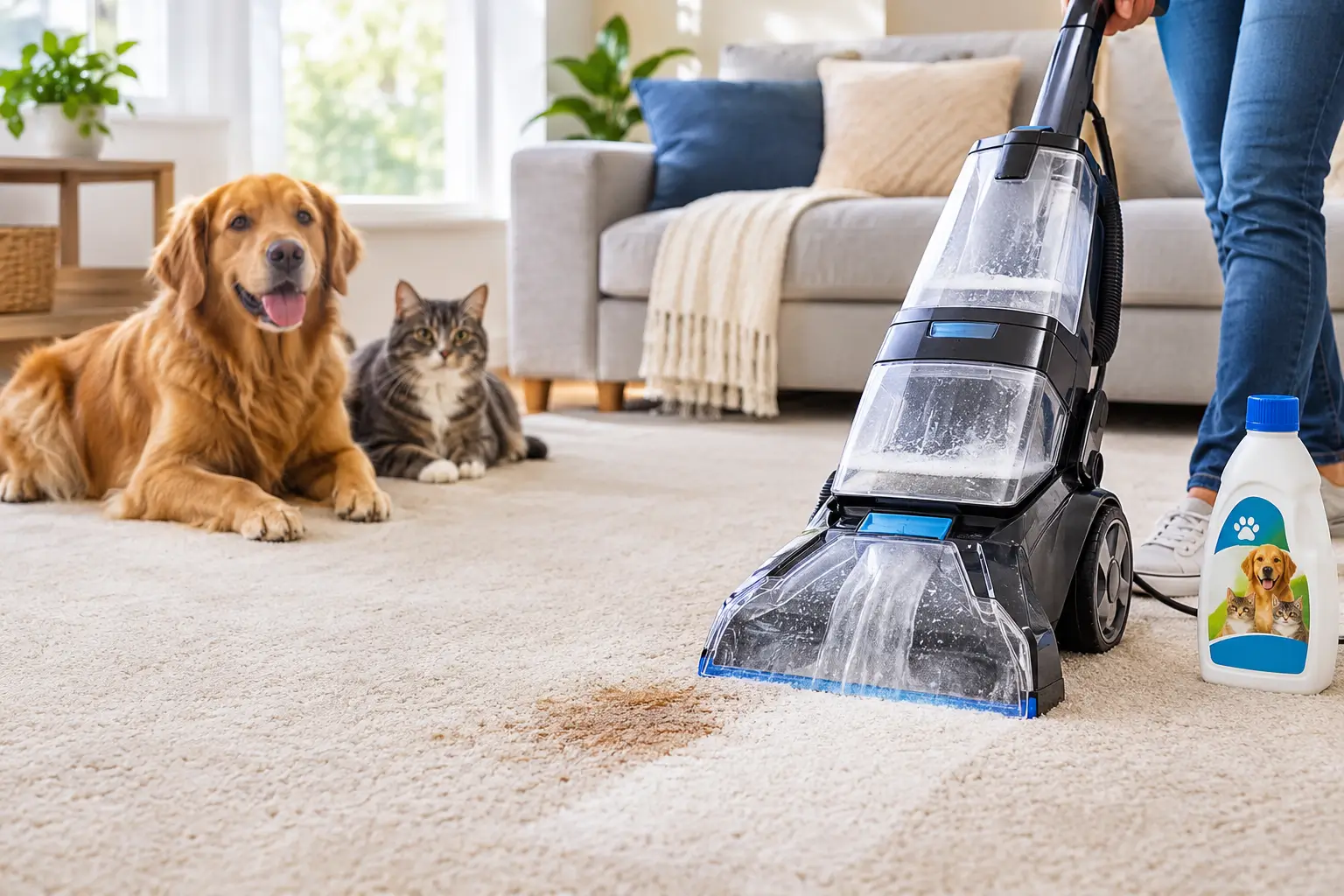
Featured Snippet Answer:
The best carpet cleaners for pets combine strong stain removal, useful attachments, good water extraction, and pet-safe cleaning practices. Portable machines suit quick accidents, while full-size cleaners work better for larger carpeted areas. For urine odors, choose a cleaner and pet-stain formula designed for the job, follow the label, and keep pets away until the carpet dries.
Key Takeaways
- Choose a portable cleaner for accidents, stairs, upholstery, and small areas.
- Pick a full-size carpet cleaner when pets regularly soil larger carpeted rooms.
- Strong water extraction matters because carpets should not stay unnecessarily wet.
- Enzyme-based products can help break down organic pet-waste odors.
- Always follow the cleaner and solution manufacturer’s directions.
- Keep pets away from freshly cleaned carpet until the product label says it is safe.
- For repeated urine accidents, cleaning the carpet alone may not solve the underlying problem.
Introduction
Pet ownership comes with plenty of good moments. It also comes with muddy paws, shedding, food spills, and the occasional accident on the carpet.
That is why many pet owners start looking for a reliable carpet-cleaning machine. A regular vacuum removes loose hair, dirt, and debris, but it does not replace deep carpet cleaning when a pet leaves behind a wet stain or odor.
The challenge comes when you start comparing machines. Some models focus on portability. Others target whole-room cleaning. Some include specialized pet tools, while others work better as general household cleaners.
The good news is that you do not need the biggest machine for every home. Your best choice depends on the type of mess you deal with, how much carpet you have, how often accidents happen, and where you plan to store the machine.
Current 2026 testing from Consumer Reports and Good Housekeeping includes several carpet cleaners that handle pet-related stains as part of their evaluations.
This guide explains what to look for, how different machine types compare, how to handle urine and other messes, and how to clean safely around dogs and cats.
What Is a Carpet Cleaner for Pets?
A carpet cleaner for pets is a carpet-cleaning machine or cleaning system designed to help remove stains, soil, and odors associated with household pets.
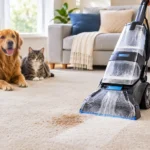
Unlike a normal vacuum, a carpet cleaner generally uses water and cleaning solution to loosen soil from carpet fibers before extracting the dirty liquid. Some machines also include specialized tools for stairs, upholstery, or small stains.
Pet-focused models often add features such as:
- Specialized pet stain tools
- Upholstery attachments
- Larger dirty-water tanks
- Strong extraction
- Pet-focused cleaning formulas
- Portable spot-cleaning designs
- Separate hoses for hard-to-reach areas
The right machine depends on your cleaning routine. Someone with two dogs and wall-to-wall carpet may need a very different machine from someone who owns one cat and mainly deals with occasional accidents.
Good Housekeeping’s 2026 testing included full-size and portable carpet cleaners and tested their ability to deal with different stains, including simulated pet-urine stains.
Quick Facts Box
| Fact | Details |
| Main job | Deep-clean carpet and extract dirty water |
| Best for | Pet stains, tracked-in dirt, spills, and carpet refreshes |
| Portable machines | Best for spot cleaning and small areas |
| Full-size machines | Better suited to larger carpeted spaces |
| Pet formulas | Look for products specifically labeled for carpet and pet stains |
| Important feature | Effective water extraction |
| Safety rule | Follow product directions and keep pets away while cleaning |
| Urine odors | May require targeted odor treatment rather than surface cleaning alone |
Key Characteristics and Care Needs
The most useful carpet cleaner is not necessarily the one with the longest feature list. Look for features that match the messes your pets actually create.
Suction and Water Extraction
Extraction matters because the machine needs to pull dirty water back out of the carpet.
A machine that leaves excessive moisture behind can make the cleaning process more inconvenient. Follow the manufacturer’s instructions for the number of passes and drying process.
Cleaning Attachments
Pet owners often clean more than floors. Dogs and cats may leave hair, dirt, stains, or odors on stairs, couches, rugs, and other fabric surfaces.
A hose and small upholstery tool can therefore make a portable machine much more useful.
Tank Size
A larger tank can reduce the number of refills during a large cleaning job. The tradeoff is simple: larger machines often take more storage space and can feel heavier.
Maintenance
After cleaning, empty dirty water, rinse removable parts as directed, and allow components to dry according to the manufacturer’s instructions.
Regular maintenance also helps prevent old dirty water and residue from becoming another source of unpleasant smells.
Quick Comparison Snapshot
| Option | Best For | Key Difference |
| BISSELL Little Green | Small accidents and upholstery | Compact portable format |
| Hoover SmartWash | Larger carpeted areas | Automatic cleaning-focused operation |
| BISSELL Revolution HydroSteam Pet | Deep cleaning and pet-focused use | Pet attachments plus steam-based cleaning features |
| Rug Doctor Mighty Pro X3 | Large or demanding cleaning jobs | Large-capacity professional-style machine |
These examples reflect products included in recent independent 2026 testing and reviews; performance, price, availability, and model configurations can change.
Best Carpet Shampooer for Pet Urine
The best carpet shampooer for pet urine should give you effective extraction and allow you to use a suitable pet-stain treatment according to its label.
Urine creates a different cleaning challenge from ordinary dirt. A surface stain may disappear while odor remains deeper in the carpet or padding.
For a fresh accident, start by absorbing as much liquid as possible. Avoid aggressively rubbing the spot because that can spread the mess through surrounding fibers.
For older odors, a pet-specific enzymatic cleaner may help break down organic waste residues. The Humane Society recommends enzymatic cleaners for pet-waste odors on washable items and discusses carpet-cleaning approaches for accident areas.
Do not assume that every carpet-cleaning machine or formula works on every carpet. Check the carpet manufacturer’s care instructions and the cleaning-product label first.
Best Carpet Cleaner for Pet Urine and Poop
A cleaner for urine and poop needs to handle more than discoloration. It also needs a sensible cleanup process for organic messes.
For solid waste, remove the material first. Then clean the affected area using a product approved for the carpet and follow its instructions.
For urine, absorb fresh moisture before applying the appropriate cleaner. Give the product enough contact time when its directions call for it.
An important point: stronger fragrance does not necessarily mean better odor removal. A product that simply masks an odor may leave the underlying residue behind.
For persistent smells, identify whether the contamination reached the carpet padding. Deep contamination sometimes requires professional carpet treatment or replacement of affected materials.
If a pet repeatedly urinates indoors, do not treat the carpet problem as purely a cleaning issue. Talk with your veterinarian about repeated inappropriate urination because medical and behavioral causes can contribute.
Top Rated Carpet Shampooer
A top-rated carpet shampooer should earn its reputation through meaningful testing, not just customer-review volume.
Consumer Reports’ 2026 carpet-cleaner testing evaluates machines for cleaning performance and specifically notes their ability to tackle tough stains, including pet stains on carpets and upholstery.
Good Housekeeping also tested more than 40 carpet cleaners and stain removers across its broader cleaning work and included pet-related stain testing in its evaluations.
When comparing ratings, look beyond the headline score. Check whether the test involved the kind of mess you actually have.
For a pet household, useful questions include:
- How well does it remove embedded stains?
- How much water does it leave behind?
- Does it include a pet tool?
- Can you clean upholstery?
- Is the machine manageable to carry?
- How easy is it to empty and clean?
- Does it fit your available storage space?
A highly rated full-size machine may not make sense for someone who only needs to clean one small accident every few weeks.
Best Carpet Cleaner for Pets 2026
The best carpet cleaner for pets in 2026 depends on the type of cleaning you need.
Current independent testing gives pet owners several categories to consider. Good Housekeeping highlights the Hoover SmartWash Automatic Carpet Cleaner, BISSELL Little Green, BISSELL Revolution HydroSteam Pet, and Rug Doctor Commercial Mighty Pro X3 Pet among its 2026 tested options.
Consumer Reports’ 2026 testing also includes the BISSELL Revolution HydroSteam Pet among the machines evaluated for difficult stains.
Instead of choosing purely by brand, match the machine to your home:
Small home: A portable spot cleaner may make more sense.
Large carpeted home: A full-size upright can save time on whole-room cleaning.
Frequent pet accidents: Prioritize easy access, useful attachments, and simple maintenance.
Occasional deep cleaning: A rental or professional service may make more financial sense than storing a large machine year-round.
Prices and availability change, so check the current retailer and manufacturer listings before purchasing.
Best Carpet Cleaner Spray
A carpet-cleaner spray can make sense when you need to treat one small stain without bringing out a full machine.
Sprays work particularly well for fresh accidents, food stains, muddy paw marks, and other localized messes when the product label approves the carpet.
For pet odors, look for a formula specifically intended for pet stains and odors. Some products use enzymes to target organic residues rather than simply covering the smell with fragrance.
Good Housekeeping’s 2026 testing included a pet stain-and-odor formula designed to address pet stains and odors and reported that its testing evaluated both stain removal and odor performance.
Always test a product according to its label and carpet-care requirements. Do not assume a product that works on synthetic carpet will work safely on wool, silk, or another specialty material.
Pet Carpet Cleaner Spray
A pet carpet cleaner spray is most useful when speed matters and the affected area remains small.
For a fresh accident, first remove solid material or absorb excess liquid. Then apply the cleaner as directed rather than soaking the entire carpet unnecessarily.
Let the product work for the amount of time stated on the label. Some enzymatic products need substantially longer contact time than ordinary spot cleaners.
The cleaning process also matters. Avoid mixing different cleaning chemicals unless the manufacturer specifically says they are compatible.
ASPCA guidance stresses that household cleaning products should be used according to their labels and that pets should stay away from treated areas when directions require it. ASPCA also recommends allowing carpet to dry before pets return to the area after carpet shampooing.
Best Carpet Cleaner for Pets Consumer Reports
Consumer Reports provides useful information for shoppers who want independent testing rather than relying only on manufacturer claims.
Its 2026 carpet-cleaner coverage says its tested machines can tackle tough stains, including stains left by pets on carpets and upholstery.
When using Consumer Reports or any testing source, pay attention to the test method. A machine that performs well on standardized stains may still have limitations in your home.
Your carpet type, stain age, cleaning solution, machine settings, and technique can all affect results.
The most useful approach is to use independent testing as one part of the decision. Then compare the machine’s size, attachments, maintenance requirements, warranty, and current price.
Best Professional Carpet Cleaner Machine
A professional-style carpet cleaner makes the most sense when you regularly clean large areas or need stronger equipment than a compact spot cleaner provides.
Good Housekeeping’s 2026 testing included the Rug Doctor Commercial Mighty Pro X3 Pet Carpet Cleaner Pack as a professional-oriented option. Its review notes the machine’s large water capacity and substantial weight, while also noting that rental can provide an alternative to ownership.
That tradeoff matters.
A large machine can handle more carpet before refilling, but it needs more storage space. Moving it around stairs or tight rooms may also take more effort.
For many pet owners, professional equipment makes more sense as an occasional rental. For homes with frequent accidents or large carpeted areas, ownership may justify the storage space.
Daily Care Routine: How to Get Started
You do not need to deep-clean your entire carpet every time your pet walks inside. A simple routine can reduce the amount of heavy cleaning you need.
1. Vacuum regularly
Remove loose pet hair, dirt, and debris before using a carpet cleaner.
2. Treat accidents quickly
Fresh stains usually give you a better starting point than stains that sit for hours or days.
3. Keep a spot-cleaning kit nearby
A useful kit can include:
- Paper towels or absorbent cloths
- A pet-specific carpet cleaner
- Disposable gloves
- A small brush if the product label allows it
- Your carpet cleaner’s appropriate attachment
4. Follow machine directions
Use the recommended solution amount and cleaning method. More solution does not automatically mean better cleaning.
5. Allow proper drying
Keep pets away from freshly treated areas according to the product label. Good ventilation can also help the carpet dry.
6. Clean the machine
Empty and rinse the machine after use according to the manufacturer’s instructions. Do not leave dirty water sitting in the tank.
Cost Breakdown
The cost of pet carpet cleaning depends on whether you buy a portable machine, purchase a full-size unit, rent equipment, or hire a professional.
Portable machines generally cost less than full-size professional-style equipment. They also take less storage space.
Full-size models cost more, but they can make sense for owners who regularly clean several rooms.
Rental can reduce the upfront cost when you only deep-clean carpets a few times per year. Good Housekeeping specifically notes rental as an option for the large Rug Doctor professional-style machine it reviewed.
Remember to include the cost of cleaning formulas, replacement parts, maintenance, and storage when comparing ownership options.
The cheapest machine is not always the cheapest long-term solution. A small portable cleaner may provide better value if it prevents you from repeatedly paying for professional spot treatment.
Common Mistakes Pet Owners Make
Using too much cleaning solution
More product can leave extra residue and may make rinsing and drying harder. Follow the manufacturer’s measurement instructions.
Scrubbing too aggressively
Hard scrubbing can spread a fresh accident and may damage carpet fibers.
Ignoring the carpet padding
If urine reaches the padding, surface treatment may not completely remove the odor.
Letting pets walk across wet carpet
Follow the cleaning-product label and machine instructions about when pets can safely return.
Mixing cleaning products
Never assume two cleaning chemicals are safe together.
Choosing a machine that is too large
A powerful machine does little good if it stays in storage because it is difficult to move.
Ignoring repeated accidents
If your pet keeps returning to the same area, clean the spot thoroughly and investigate why the accidents continue.
Pros and Cons
| Pros | Cons |
| Helps remove deep dirt and stains | Machines require storage space |
| Useful for pet accidents | Some models are heavy |
| Portable models handle quick messes | Small tanks need more frequent refilling |
| Can clean carpets and some upholstery | Cleaning and maintenance take time |
| May reduce the need for professional cleaning | Results depend on carpet, stain, product, and technique |
| Useful for multi-pet homes | Cleaning formulas add ongoing cost |
Similar Products and Alternatives
Not every pet owner needs a dedicated carpet-cleaning machine.
| Option | Best For |
| Portable spot cleaner | Apartments and occasional accidents |
| Full-size upright cleaner | Large carpeted homes |
| Pet stain spray | Fresh localized stains |
| Enzymatic odor treatment | Organic pet-waste odors |
| Rental carpet cleaner | Occasional whole-home deep cleaning |
| Professional carpet service | Severe, widespread, or difficult contamination |
A portable cleaner and a full-size machine solve different problems. A spray can handle a small accident without requiring a machine at all.
For severe contamination, especially when odor continues after repeated cleaning, professional help may provide a better solution than repeatedly treating the same area.
When to Consult a Vet or Professional
A carpet cleaner can solve a cleaning problem, but it cannot diagnose why your pet had an accident.
Contact your veterinarian if your pet suddenly starts urinating or defecating indoors, especially if the behavior repeats or comes with other changes. Medical problems can sometimes contribute to changes in bathroom habits.
For the carpet itself, consider professional cleaning when urine has soaked deeply into padding, when odors remain after appropriate cleaning, or when a large area needs treatment.
Do not use stronger chemicals simply because ordinary cleaning did not work. ASPCA advises pet owners to follow product directions and seek veterinary or manufacturer guidance when they have questions about a cleaning product’s use around pets.
Fun Facts
- Carpet cleaners and vacuums perform different jobs. A vacuum primarily removes loose debris, while a carpet cleaner uses liquid cleaning and extraction.
- Portable carpet cleaners can also help with stairs and upholstery when the manufacturer permits those surfaces.
- Some professional-style carpet cleaners have much larger water tanks than portable models.
- Independent testing often uses standardized stains to compare cleaning performance.
- Pet urine can create an odor problem that requires more than surface stain removal.
- Enzymatic cleaners target organic residues rather than simply adding fragrance.
- ASPCA advises keeping pets away from freshly shampooed carpet until it dries.
- Carpet type matters. Always check the manufacturer’s care instructions before applying a new cleaning product.
Frequently Asked Questions
What are the best carpet cleaners for pets and pet stains?
The right carpet cleaner depends on the type and size of the mess. Portable machines work well for isolated accidents, stairs, upholstery, and small carpeted areas. Full-size machines make more sense when pets regularly soil multiple rooms. Independent 2026 testing from Consumer Reports and Good Housekeeping includes several machines that perform well on difficult stains, including pet-related stains.
For a buying decision, focus on extraction, attachments, tank capacity, machine weight, maintenance, and current price. Match those features to your home instead of choosing a machine simply because it carries a “pet” label.
What carpet cleaner works best for dog and cat urine odors?
Urine odor often requires more than ordinary surface cleaning. Start by absorbing fresh urine and then use a pet-specific odor treatment according to its label. Enzymatic cleaners can help break down organic residues associated with pet waste. The Humane Society recommends enzymatic cleaners as part of its guidance for removing pet-waste odors.
If the smell continues after proper treatment, urine may have reached carpet padding or another underlying material. At that point, repeated surface spraying may not solve the problem. A professional carpet assessment can help determine how deeply the contamination traveled.
Are carpet cleaners safe to use around dogs and cats?
Many carpet-cleaning products can be used in pet homes when owners follow the product label correctly. ASPCA advises keeping pets away from freshly shampooed carpet until the area dries and stresses following usage directions.
Safety also depends on the specific product and animal. Cats, dogs, birds, and other pets can react differently to household chemicals. Store cleaning products securely, avoid unnecessary exposure, and never let a pet lick wet cleaning solution. If exposure occurs or your pet develops concerning symptoms, contact a veterinarian or animal poison-control service promptly.
What should you look for when choosing a carpet cleaner for pets?
Start with the type of cleaning you actually need. For occasional accidents, prioritize a lightweight portable machine with a hose and useful spot-cleaning tool. For large carpeted homes, consider a full-size machine with a larger tank and strong extraction.
Also check whether the machine supports your carpet type and whether the manufacturer approves the cleaning solution you plan to use. Easy maintenance matters because pet owners often need to clean machines after messy accidents. Finally, compare independent test results, warranty information, replacement-part availability, storage requirements, and current price rather than focusing on one feature.
How do you remove old pet stains and odors from carpets?
Old stains require patience because the contamination may have penetrated deeper than the visible carpet surface. Begin by checking the carpet manufacturer’s care instructions. Then use a pet-specific stain or odor product that is appropriate for that carpet and follow its label exactly.
Avoid mixing cleaning chemicals or repeatedly soaking the same area without knowing what lies underneath. If the odor returns after drying, the carpet padding may hold residual contamination. Professional carpet cleaning may help in severe cases. If the pet continues to soil the same location, also investigate the reason for the repeated accidents instead of treating the carpet alone.
Final Thoughts
Choosing a carpet cleaner for a pet home comes down to matching the machine to your real cleaning routine.
A compact portable cleaner can make sense for occasional accidents, stairs, upholstery, and small homes. A full-size machine can save time when pets regularly create messes across several rooms. A spray may be all you need for a small fresh stain.
The most important features are not always the flashiest ones. Good extraction, practical attachments, manageable maintenance, and compatibility with your carpet and cleaning solution matter more.
Pet safety should also remain part of the decision. Follow product labels, keep animals away from wet cleaning solutions, and let treated carpet dry as directed. ASPCA specifically recommends following cleaning-product directions and keeping pets away from freshly shampooed carpet until it dries.
If repeated accidents or deep odors continue, look beyond the carpet. Your pet may need veterinary attention, or the carpet may need professional treatment.

Emily Carter is a pet care writer at PetJournalHub. She enjoys creating clear, practical, and well-researched articles about pet health, nutrition, grooming, and everyday care. Her goal is to help pet owners make informed decisions through reliable, easy-to-understand content.